Tuesday, April 13, 2010

Don Matteo

Don Matteo is an Italian television series that has been airing since 2000 on Italian national television, Rai Uno. 


Protagonist of the series is father Matteo (portrayed by Terence Hill), a Catholic priest in a parish of the town of Gubbio (PG), who is also known for his unrivaled talent in investigating local crime stories. 


Father Matteo is a wise and respected person who understands people's problems and always appears to be willing to help. Thanks to his charm and positivity, he often helps criminals on their way to redeeming and he always convinces them to confess their crimes and to accept their responsibilities.


Again, thanks to Massimo

Monday, April 12, 2010

Bike Series #5 - Tornado Smith

More on the Wall of Death (see previous post Bike Series #1). 

Tornado Smith, the Wall of Death rider from Southend, and his wife having tea with their pet lion and lamb.  
George “Tornado” Smith brought the Wall of Death from America to England in 1929, and featured such spectacles as ”Briton the Wall-riding lion” and “Gymkhana Girls and Girl Protégées” in his billing.  Check out the skull-and-crossbones badge on his beret, he’s nowhere near as mild-mannered as he looks.  –Derek Berwin/Hulton Archive
Tornado Smith posts a letter while riding his penny farthing bicycle. He is wearing a learner plate and his bike is advertising his Wall of Death act. –Derek Berwin/Hulton Archive
* 
(above) Circa 1935, Earls Court, London — Tornado Smith, who entertains the crowds at Olympia with his Wall of Death ride, is seen riding a penny-farthing on the Earls Court Road. — Image by © Hulton-Deutsch Collection
(below) Circa 1936, Southend-on-Sea, England — Mr. “Tornado” Smith, a stunt motorcyclist, clips the toenails of his pet lion, at home. — Image by © Hulton-Deutsch Collection.

Saturday, April 10, 2010

Miguel de Unamuno y Jugo


Miguel de Unamuno y Jugo (1864 – 1936) was an essayist, novelist, poet, playwright and philosopher from Bilbao, in Spain's Basque Country.


Unamuno served as rector of the University of Salamanca two periods: from 1900 to 1924 and 1930 to 1936, during a time of great social and political upheaval. Unamuno was removed from his post by the government twice, first in 1924, banished to Fuerteventura on the Canary Islands, from where he escaped to France. 
Unamuno returned after the fall of General Primo de Rivera's dictatorship and took up his rectorship again. It is said in Salamanca that the day he returned to the University, Unamuno began his lecture by saying "As we were saying yesterday, ...", as Fray Luis de León had done in the same place four centuries before, as though he had not been absent at all. After the fall of Rivera's dictatorship, Spain embarked on its Second Republic. He was a candidate for the small intellectual party Al Servicio de la Republica.
The Republic was squashed when a military coup headed by General Francisco Franco caused the outbreak of the Spanish Civil War. 


As a result of his opposition to Franco, Unamuno was effectively removed for a second time from his University post. Also, in 1936 Unamuno had a brief public quarrel with the Nationalist general Millán Astray at the University in which he denounced both Astray and elements of the Francoist movement. He called the battle cry of the rightist Falange movement—"Long live death!"—repellent and suggested Astray wanted to see Spain crippled. One historian notes that his address was a "remarkable act of moral courage" and that he risked being lynched on the spot. Shortly afterwards, he was placed under house arrest, where he remained, broken-hearted, until his death ten weeks later.

Friday, April 9, 2010

Naughty Paris

The silhouette of a naked woman with beret and shopping bag is meant to symbolize the pleasures of visiting Paris.
Naughty Paris is a guide book to Paris for women, by women. I quote:
Naughty Paris: A Lady’s Guide to the Sexy City is the first guidebook that presents the city’s erotic underside in a sophisticated yet accessible tone that appeals to both the innocently intrigued and daring divas alike. Whether you want to be titillated by erotic art or seduced at the city’s most exclusive swingers’ clubs, this guide is the key to choosing your own adventure.
Despite the promising cover, I didn't find any reference to berets inside the book...

Thursday, April 8, 2010

Mt Ruapehu, Plato Grandes and Swannies

After a summer of wearing cotton Tolosa Tupida berets, a long Easter weekend away in the mountains was a great opportunity to wear my TT Plato Grande, a 34cm wide giant, the Argentinean answer to the Spanish made txapelduns. 
And it felt good, that large piece of felt on top of my head, crossing one of the lower passes on the old volcano in a fine drizzle.
 BlackBerry Wallpaper > Nature > Mount Ruapehu, Tongariro National Park, New Zealand

Of course, I had to cope with the smirks from real Kiwi blokes, baseball-capped and dressed in shorts and wearing jandals, but... one get's used to that, being a beret aficionado living in New Zealand.
Fortunately, I did wear my Swannie bushshirt as well.

Wednesday, April 7, 2010

Txapela's or Boinas Plato Grandes


The Txapeldun is the quintessential Basque beret, the most perfect embodiment of a tradition that goes back centuries, a symbol for champions (the Txapeldun is often used as a trophy in competitions of sports and the brain), the ultimate protection from sun, rain and snow for the Basque shepherds in the Pyrenees mountains, a hat widely adopted by artists with a reminiscence of the Renaissance and generally, a fantastic beret to wear.

South Pacific Berets now sell two sizes of Txapelduns, the 15" and the very-very large diameter in 16" (which is respectively 13.7" and 14.6" in US sizes and 34.9cm and 37.2cm in the Metric system).
For those who want a very large diameter beret, but find the Txapeldun a bit too much - have a look at the Elosegui Plato Grande, a Super Lujo beret in 14" (12.8 US" or 32.6cm). 

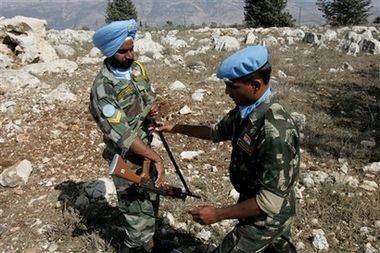
EU Berets vs UN Turbans

Everyone his or her own taste, of course, but I can't help not seeing any beauty, or considerations to fashion in any way, in these European Union Monitor berets.


Sure, they may perform a noble job (in theory, at least), in a world that can do with a lot more monitoring, but personally, I'd much rather see a Sikh in his UN-blue turban at a checkpoint.

Tuesday, April 6, 2010

Pierre Labric's Bike Ride down the Eiffel Tower

Found on Vanessa's Joie de Vivre blog, a tribute to Parisian organist, and later mayor of Montmartre, Pierre Labric:


In 1923, as France was in the throws of recovering from the first world war, Pierre brought some much-needed entertainment to the city by riding a bicycle down the Eiffel Tower from the first level (out of three). Some accounts say that he rode down the stairs, others suggest the exterior of one of the tower's four legs which slope outward. 
The man himself (with the beret and dog on the right):


And just to show how far off the ground the first level is:

Monday, April 5, 2010

Bike Series #4 - Bicycle Matchmaker: Woodstock’s Michael Esposito


This article comes from The Faster Times, by Tusha Yakovleva.
dsc05905 Bicycle Matchmaker: Woodstocks Michael Esposito
Michael Esposito is built like a bicycle. Tall, lean, and graceful. He glides, vigilant and stern, his expression softened by a maroon beret. In the morning, you can find him at any one of the town’s cafes. With a hot drink in hand and his bike parked outside, he is greeted with multiple  “Good Mornings!” at every swing of the door. He has a separate response to each, as anyone who has spent half a century in this one-street town would.
The town is the legendary Woodstock, New York. A 6,000 person community just like any other according to Michael,  only that “we’ve had more famous people per capita.” Michael first came up to record with Happy and Artie Traum. He stayed, leaving behind the whirlwind of New York City.
Forty years later, things have changed. “Now, Woodstock’s just your average tourist town, with that little twinge of being famous a few times in the last hundred years. But, the old feeling of the artists and musicians is still here,” he says. And the town has a stronger hold on him than ever, a bond that Michael decided to preserve by purchasing a plot at the Woodstock Artists’ Cemetery. After all, Woodstock has been his home through all his various incarnations, from landscape painter to Western Orthodox Priest, to local bicycle savior at Old Spokes Home.
dsc05942-2 Bicycle Matchmaker: Woodstocks Michael Esposito
Twenty-six years ago, Michael inherited some bike tools. “They sat around for a while and then people started coming to me.” Then, someone offered him a beige, slightly asymmetrical garage, right behind the main street. Ever since that day, Michael has been Woodstock’s most successful matchmaker, pairing up thousands of feet to pedals.
Michael’s own bicycle has a large industrial flashlight strapped to the front, in lieu of a headlight. In the back, he has attached a miniature novelty plate that spells “MICHAEL.” He hasn’t driven a car since ’77, and generally stays within a 10 mile radius of Woodstock, biking, or, when defeated by wind-chill, walking.
The inside of Old Spoke’s Home has the diluted smell of an aired out mechanics shop, a mixture of rubber and whatever magic ointments Michael concocts to bring his old rusty friends back to life. The bicycles hang limply from the ceiling, or sit in piles in corners like shelter pets, trying their best to look appealing.
dsc05919 Bicycle Matchmaker: Woodstocks Michael Esposito
When one is chosen, Michael carries it outside and goes to work. It may take an hour, or a couple of days, but by the end of the operation the bicycle breathes anew. The vehicle is then appraised and joins the row of other rescues parked proudly in front of the shop. Michael’s favorite moment is when someone brings in a bike they haven’t used in years. He fixes it up and then watches the happy customer ride it about town, every day. “Once you discover the bike again, it’s a lifetime thing. Our councilman is in his 80s and he’s still riding.” His one ulterior motive is sustainability. A biker on the road means, “that much less time that there is pollution in the air.”
dsc05939-2 Bicycle Matchmaker: Woodstocks Michael Esposito
What makes Michael’s service truly unique is that he is in the resurrection business. Most places will offer a new bicycle rather than dealing with the old because that is how the world works these days, he says. And, since all parts are donated, it only costs him time, for which he charges so little. Michael would likely go hungry before denying someone a set of wheels.
He almost did, too. He was far behind on his mortgage. Woodstock people, however, quickly wrangled up Michael’s friends and now he is fine. “I was screaming, ‘No, I don’t want a benefit, it’s embarrassing!’ They said, ‘Sorry, it’s already under way.’” John Sebastian, Happy Traum and many other players from all over town showed up to help.
Michael would like painting to be his next livelihood. He does about 20 painting every winter (the bike garage door literally freezes shut till April, so the bike business hibernates). He would also like a nice steady job. When it comes to that, though, Woodstock’s offers are slim. There just isn’t much work, and $7.50 an hour or less isn’t very appealing.
From the coffee shop windows, Michael looks out onto the cyclists passing by the window as a proud grandfather looks at his young flock. He is celebrating seventy this year and is rarely seen without his maroon beret.
dsc05943_31 Bicycle Matchmaker: Woodstocks Michael Esposito

Saturday, April 3, 2010

Gauchos con Boina (2)

Some of the best pictures of beret wearers come from the South American pampas. Gauchos from Argentina, Brazil, Chile and Uruguay widely adopted the beret, or boina as their preferred (and most practical) headgear.


 Whether cotton berets from Argeninean manufacturer Bonigor SA and the Fabrica Nacional in Uruguay (the 3 top pictures),


or the merino version in small diameter Italian style, or Plato Grandes and Txapelduns, Argentinean and Spanish made.

Friday, April 2, 2010

Postcards

www.delcampe.net is a web site for collectors of stamps, badges, pins. documents, the occasional old beret and, among other collection-able materials, postcards.
From a pre-email era, I found an enormous collection of beret-related postcards, mostly from the early 20th century, a few from the second half of that century. 
Beautiful scenes, the berets as interesting as the backgrounds and environments; whether it is the street without traffic, the fishermen on the beach
or a Basque Frenchman making soup,
or photographs in Paris' Jardin du Luxembourg,
they are evidence of a bygone era.

Thursday, April 1, 2010

Baldness and Berets

A major complaint of soldiers in the US armed forces at the introduction of the beret as part of their uniform was that a beret would increase baldness - a story I have heard often and still hear from people who'd like to wear a beret, but fear their already bald spot may grow bigger. 
I always dismissed this belief as nonsense, but research at the University of Castillo-La Mancha in Toledo (Spain) confirmed that there actually is some truth in this. 
 John Sepie - Wood Artist / Potter
Enrique el Mentiroso de Abril, lecturer at the Dept. of Organic Chemistry explains that the interaction of the "rough" wool with the human hair of the scalp, creates a low-tone electric field that diminishes, and in the end completely stops, the growth of hair. This is especially valid where there is frequent movement between the two entities - an active soldier runs a higher risk than an office worker sitting behind his desk. 
Ironically, many soldiers instantly rip out the satin lining in the belief that it looks better and more macho to have an un-lined beret; Rastafarians, on the other hand, generally line their berets with a bamboo based liner, similar to satin.
Rastafarian
The good news is that when a beret has a satin lining, the trend is actually reversed! The gentle rubbing of the smooth satin against the scalp stimulates the growth from the follicles found in the dermis and can actually increase hair-growth by up to 2 mm per week! Boinas Elosegui, a participant in the study, immediately announced a stop of un-lined berets sales.


South Pacific Berets managed to get hold of 100 loose satin liners from Hills Hats NZ, which are available for postage cost only to existing customers (drop me a line with desired number of liners and I'll get them on their way). 

Wednesday, March 31, 2010

Tarte Chasseur

Earlier on in The Beret Project, I wrote a post "Size Does Matter" and everyone familiar with berets would agree - it makes a huge difference whether you have a 25 or a 35cm (9.5" or 14") on top of your head. I have a liking for the larger diameters, 28cm (11") as an absolute minimum, but then, I am blessed, or not, with a rather large head. 
Little choice when you are in the military and, if you happen to have a small head, you can question your luck when you are placed with the Chasseurs Alpins. I can't help admiring this French captain, instructing Afghan soldiers in pistol shooting; I guess he's a size 55 or so, but despite that, he manages to wear his "tarte" with style. 

Tuesday, March 30, 2010

Berets Rock!


It is one thing to create a statue or a sculpture of a man wearing a beret in papier maché,


stone or even glass, 

but personally I am more impressed by what Nature manages to create without human help, like this sharp-nosed Basque in Goblin Valley, Utah (USA).


Or the next picture, from an unknown location in Spain:


Monday, March 29, 2010

Henry Heerup


Henry Heerup (1907 - 1993) was a painter and sculptor born in Frederiksberg, Denmark.

He studied painting under Axel Jørgensen and Einar Nielsen at the Royal Danish Academy of Art. He also studied sculpture there under Einar Utzon-Frank. He painted The Old Oak in Wolfvalley in 1924. This was his first oil painting.
Henry Heerup married Emilie Westh in 1933. During the 1930s he developed his trash sculptures. During the 1940s he became a member of Corner and Høst and exhibited with them.

In 1949 he joined COBRA and participated in some of their exhibitions. He developed an international reputation exhibiting across Europe and North America. The film A Year with Henry was made by Jens Jørgen Thorsen and Jørgen Roos and premiered in 1967. Heerup was made a member of the Order of the Dannebrog in 1968.

Saturday, March 27, 2010

Nemea

I was quite taken by this watercolour by Californian artist Susan Cornelis; something tragic, melancholic about the picture that I find hard to pinpoint.
Susan says:
I think she (the model) said she named herself Nemea after the Greek town where the games were held (in the nude).


nemea2Nemea said she needed a beret, so one of the artists ran out to their car and brought back the hat. 

Friday, March 26, 2010

Colleville-Montgomery

Colleville-Montgomery is a "commune" in the Calvados department in the Basse-Normandie region in northern France and, as far as I know, the only municipality in the world with a beret in it's shield of arms (correct me if I am wrong, please). 


From the commune's web site:

The momentous events of June 6th, 1944 transformed Colleville-sur-Orne from an unassuming village on the plateau to the north of Caen into Colleville-Montgomery, the celebrated site where Commandant Kieffer's French commando landed on the D-Day beach alongside the Allies.
Since those times, the village has continued to develop and grow...
Today, proud of its cultural and historical heritage and its unspoilt natural environment, the village offers visitors who stop by both the simple pleasures of the seaside and the charms of the countryside.
Statue of 'Monty' at Colleville-Montgomery, Calvados, France (close to 'Sword Beach'). In September 1944 Field Marshal Montgomery decorated Corporal Jim 'Marra' McGuinness with the Military Medal for his part in the attack on Merville Battery, D-Day 6 June 1944.