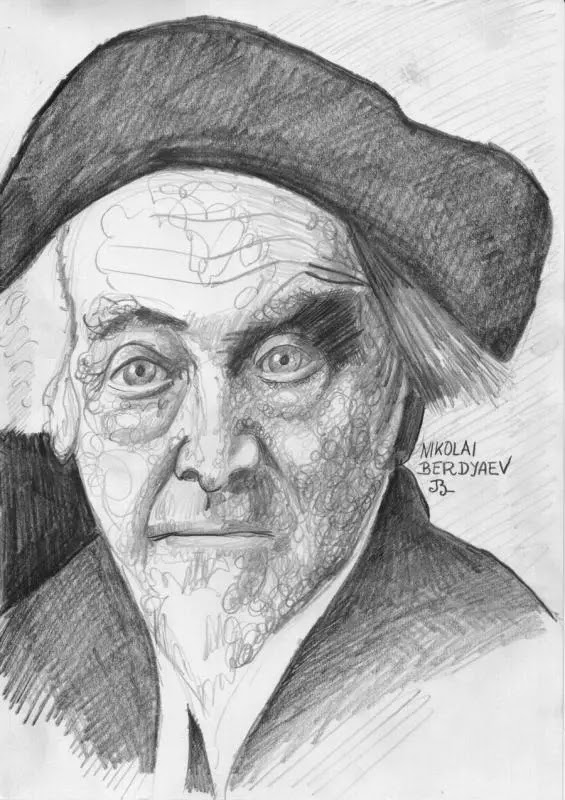
Nikolai Alexandrovich Berdyaev (1874 –1948) was a Russian
philosopher, theologian, and Christian existentialist who emphasized the
existential spiritual significance of human freedom and the human person.
Berdyaev decided on an intellectual career and entered the
Kiev University in 1894. It was a time of revolutionary fervor among the
students and the intelligentsia. He became a Marxist for a period and was
arrested in a student demonstration and expelled from the university. His
involvement in illegal activities led in 1897 to three years of internal exile
to Vologda in northern Russia.
A fiery 1913 article, entitled "Quenchers of the
Spirit", criticising the rough purging of Imiaslavie Russian monks on
Mount Athos by the Holy Synod of the Russian Orthodox Church using tsarist
troops, caused him to be charged with the crime of blasphemy, the punishment
for which was exile to Siberia for life. The World War and the Bolshevik
Revolution prevented the matter coming to trial.
In 1920, Berdiaev became professor of philosophy at the
University of Moscow. In the same year, he was accused of participating in a
conspiracy against the government; he was arrested and jailed. The feared head
of the Cheka, Felix Dzerzhinsky, came in person to interrogate him, and he
gave his interrogator a solid dressing down on the problems with Bolshevism.
After being expelled from Russia, Berdyaev and other émigrés
went to Berlin, where he founded an academy of philosophy and religion, but
economic and political conditions in the Weimar Republic caused him and his
wife to move to Paris in 1923. He transferred his academy there, and taught,
lectured and wrote, working for an exchange of ideas with the French and
European intellectual community, and participated in a number of international
conferences.


.jpg)


.jpg)










.jpg)


,%20often%20referred%20to%20as%20Abbe%20Breuil.%20French%20Catholic%20priest,%20archaeologist,%20anthropologist,%20ethnologist%20and%20geologist.%20Portrait..jpg)


