Two photos by my brother Frans, taken on his way to the Hasselt (Belgium) railway station.


Two photos by my brother Frans, taken on his way to the Hasselt (Belgium) railway station.
John Sinclair (1941 –2024) was an American poet, writer, and political activist from Flint, Michigan.

Sinclair's defining style is jazz poetry, and he released
most of his works in audio formats. Most of his pieces include musical
accompaniment, usually by a varying group of collaborators dubbed Blues
Scholars.

In 1972, Ann Arbor's annual marijuana celebration and Toke and Smoke Fest in the Diag began. This was four months after the John Sinclair Freedom Rally, who was at the time still serving time on his ten-year sentence for possession of two joints. John Lennon had come to that rally and penned a song.

Sinclair made a career of being a poet and promoter. He also promoted concerts and festivals and helped to establish The Detroit Artists Workshop and Detroit Jazz Center were among his promoted events, as were other concerts and festivals. At Wayne State University he taught Blues history and hosted radio programs in Detroit WDET, New Orleans, and Amsterdam.

Still Open All Hours is a British sitcom created for the BBC by Roy Clarke, and starring David Jason and James Baxter. It is the sequel to the sitcom Open All Hours, which both Clarke and Jason worked on throughout its 26-episode run from 1976 to 1985, following a 40th Anniversary Special in December 2013 commemorating the original series.

The sitcom's premise focuses on the life of a much older Granville, who now runs his late uncle's grocery shop with the assistance of his son, continuing to sell products at higher prices alongside seeking to be with his love interest.

Unlike the original series, the cast for Still Open All Hours includes a more regular group of characters and additional side-plots.

A seventh series had been commissioned in 2019, but was delayed by the COVID-19 pandemic and despite plans to record it, the series was eventually cancelled in 2023, with the BBC saying it had no plans for any new episodes.
Anne-Marie Rose Nicholson (1991) is an English singer-songwriter.

She has attained various charting singles on the UK Singles Chart, including Clean Bandit's "Rockabye", which peaked at number one, as well as "Alarm", "Ciao Adios", "Friends", "2002", "Don't Play" and "Kiss My (Uh-Oh)".

In 2018, Anne-Marie revealed that she is attracted to both men and women, but that she does not identify with the label bisexual; "I just feel like I'm attracted to who I like."

Anne-Marie has been a vegetarian since 2018, however she stated that she will "try to eat vegan [food] as much as possible".

Anne-Marie’s first book "You Deserve Better: An Imperfect Guide To Finding Your Own Happiness" was a Sunday Times bestseller. As of 8 February 2022, the book has sold over 10 000 copies. The Korean version of the book was published on 23 February and was the only official translation.
,%20Lock%20at%20Pompeii.jpg) |
| Lock at Pompeii |
Laurits Andersen Ring (1854 –1933) was one of the foremost Danish painters of the turn of the 20th century, who pioneered both symbolism and social realism in Denmark.
 |
| Lock at Pompeii, detail |
In Ring's art the road and the path are recurring themes,
and other lines such as creeks, rivers and estuaries, the open sea and modern
elements e.g. bridges, railway tracks and telephone cables are used as main
motifs. The roads lead the eye into the paintings and out again, as a symbol of
the human existence.
,%20Herman%20K%C3%A4hler%20in%20his%20Workshop%20(1890).jpg) |
| Herman Kähler in his Workshop |
Ring painted landscapes, but in the beginning of his career
it was not the landscape painting that dominated his art. Up until 1887 there
were about 10 landscape paintings out of approximately 90 works of art in his
repertoire. From 1888 and until his death in 1933 the landscape painting
however made up about three quarters of his production.
,%20A%20Turner%20at%20his%20Lathe%20(1890).jpg) |
| A Turner at his Lathe |
Joseph-Amable Dubé was one of 27 children growing up near Montréal at the end of the Great Depression. His family was struggling to get by, and his dad was working only one day a week. As Canada was being pulled into the Second World War, he decided to enlist.

At 14 years old he was too young to serve, but determined to serve he managed to alter his baptism certificate with some blotting paper. Before he knew it, he was a member of the Royal 22nd Regiment — the famed Van Doos — at Valcartier.

In September 1943, he was deployed to Italy to participate in the Battle of Monte Cassino during the Italian Campaign.
Due to his short stature and young age, Pte. Dubé earned the
nickname “ti-cul” from his comrades. He fought for 24 days at Monte Cassino and
witnessed his brothers get crushed by a massive 12-foot wall. He was ordered to
help retrieve the injured and killed men with no tools — just his rifle. He
used it to lift the rubble off the men.
After the war, he was personally thanked by Queen Elizabeth
II before returning home to Montréal.
Diana Spencer-Churchill (1909 –1963) was the eldest daughter of British statesman Sir Winston Churchill and Clementine Churchill, Baroness Spencer-Churchill.
,%20eldest%20daughter%20of%20Winston%20and%20Clementine%20Churchill.%20Pictured%20in%201935.jpeg)
She was an officer in the Women's Royal Naval Service during the Second World War.
Churchill had several nervous breakdowns. In 1962, she began working with the Samaritans, an organisation created for the prevention of suicide. She committed suicide on 20 October 1963 from an overdose of barbiturates. She is buried with her parents (who both outlived her) and her siblings.
Herman Makarenko (1961) is the conductor of the National Academic Opera and Ballet Theatre of Ukraine named after Taras Shevchenko and the chief conductor and artistic director of the Kyiv Classic Orchestra.

Herman Makarenko is an adherent of charitable projects, he is convinced that music can heal human soul: “If you feel good, you need to share your happiness with those who need it,” he says. Therefore, he and the Kyiv Classic Orchestra take part in charity Viennese balls around the world, organizes interactive concerts for children for the New Year and St. Nicholas Day.

The orchestra under his direction can be seen not only on opera stages, but also in social centers, children's hospitals and even in art projects in the subway.
Joseph Anthony Dallet Jr. (1907 –1937) was an American industrial worker, labor and communist organizer.

From a wealthy family, Dallet was involved in the American labor movement early on, taking industrial jobs such as docker or steel mill worker. He joined the Communist Party USA and ran for local U.S. House Of Representatives seats.
In 1934 he became the common law husband of Kitty Puening,
who would later marry physicist J. Robert Oppenheimer.

In 1937, he volunteered for the Republican army in the Spanish Civil War. Dallet was killed in his first battle, on the Aragon front near Fuentes de Ebro.
Seville is one of Youtube blogger Primemutton's favourite stomping grounds. While many explore the many sights and eateries in the city, many forget to pop across the river and sample the many superb tapas bars mainly frequented by locals and Spanish tourists in the district of Triana.
Mutton sets the record straight in an epic tapas crawl covering 10 bars and samples 15 tapas of incredible variety, with beret.Berets as a headdress for military personnel in the Soviet
Union dates back to 1936.
 |
| Marya Dolina; PE2 Pilot and Dep. Sqn. Commander of the women's 125th Guards Bomber Regiment |
By order of the NKO of the USSR dark blue berets became part
of the female summer uniforms and for students of military academies.
In 1963, Ministry of Defence order 248 introduces a new
field uniform for the Special Forces and USSR Marine Corps – including berets.
Privates/sailors and nco’s wore black cotton berets; officers berets in black
wool. A red star was placed at the centre front and a flag badge was stitched
to the left side of the beret.
June 1967 saw the introduction of berets for the airborne forces. Designer/artist A. B. Zhuk proposed maroon berets, as was typical for airborne troops around the world. These were worn during the November 1967 parade, but soon after, were replaced by light blue berets as the military leadership didn’t want to conform to western ideas and thought ‘sky blue’ more appropriate for paratroopers.

Prior to the Red Square parade of 1968, beret badges were
moved to the right side, so to be visible for the top brass watching
from Lenin’s mausoleum (no joke).

Next were the units of the armoured corps, who got black berets (following the western trend) in 1972.

In 1989 the troops of the Ministry of the Interior (MVD) got
olive coloured berets and could earn the maroon beret by qualifying in tests,
courage or in battle.

Meanwhile, a camouflage cotton beret became standard issue
for infantry and a green beret for border troops.

All these berets were typical Soviet/Warsaw Pact models: not knitted and felted, but made of
various pieces of woven felted wool sewn together, fitted with a fake leather
rim and 4 air vents (2 on each side). A similar model is still made in Poland: the Warszawski and Sosabowski berets.

Right at the end of the USSR’s existence, an orange beret was introduced for the Ministry of Emergency Situation troops.


A painter, muralist and long-time teacher at the New School of Social Research in New York, Anthony Toney was born to Syrian immigrants in Gloversville, New York on June 28, 1913.

He received a university stipend to study in Paris in 1937. Alarmed by the fascist movements sweeping Europe, Mr. Toney sneaked across the Pyrenees into Spain and joined the volunteer Abraham Lincoln Brigade fighting against Gen. Francisco Franco's forces in the Spanish Civil War.
Wounded at the Battle of Ebro, he returned to New York and worked again for the WPA. During World War II, Mr. Toney served as a flight engineer in the Army Air Forces in the South Pacific and was awarded the Distinguished Flying Cross.”

Toney, who took advantage of the GI Bill to get a doctorate in fine arts and education at Columbia , began teaching at the New School in 1952. He painted two enormous murals at Syracuse University, one of which, Man and the Universe (above), includes portraits of nearly a hundred scientists and is still on view.

His work is marked by an intellect that looked at the world and saw a complex reality. For him realism was not a mirror of the natural world, but a more abstract idea which included political and psychological forces. His strong aesthetic was influenced by the movements that preceded him- impressionism, expressionism and cubism as well as the foundations of the old masters.
He moved to Fairfax, California in 1997 and, with his beret and sketchbook, became a familiar figure around town. He volunteered at the local elementary school, delighting kids whose portraits he did.
La Bouchée de pain (The Bite of Bread) is a painting by Fernand Pelez on commission from the Ministry of Fine Arts in 1881 on the theme of “Charity”.
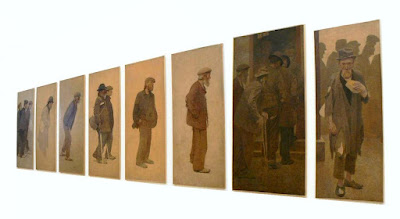
The implementation of this large composition did not begin until after 1900 and was completed in 1908. Ten preparatory sketches are kept at the Petit Palais. They are painted in shades of brown in the style of ink washes. The characters are represented in groups or individually, life size.

Urban poverty primarily affects low-skilled workers and sick people who are left jobless and destitute by economic crises. Faced with the delay in social reforms, Catholic organizations still occupied a predominant place in charitable action at the end of the 19th century. Opened on rue Cujas, the work of the Bouchée de pain was named in reference to the last meal of Jesus with the apostles.

Paul Mayer (1931–2013) was a German-born American peace activist. Mayer is best remembered as a leading radical pacifist of the 1960s and early 1970s, taking part in acts of civil disobedience in an effort to speed an end to the Vietnam War.
Paul Michael Mayer was born in Frankfurt, Germany to Ernst and Bertha Mayer, German Jews. His father was a concert violinist who made ends meet working as his salesman, while his mother worked as a nurse.

Following the rise to power of Hitler and his Nazi party, Mayer and his younger brother were expelled from school by government edict, contributing to his parents' decision to emigrate to the United States in 1938. He spent a year living in an orphanage before his parents were financially able to obtain an apartment for the family in New York City.
Mayer converted from Judaism to Catholicism in 1947, at the age of 16, drawn to the church, he later recalled, by an "adolescent drive to belong." Aspiring to become a priest, Mayer joined a Benedictine monastery, where he lived for 18 years.

Mayer was deeply affected by liberation theology in the Catholic church, with its emphasis upon aiding the poor by battling unjust economic, political, and social conditions.
During his last years Mayer became involved with the Occupy
Wall Street movement, expressing an affinity for its radical political ideology
and anti-poverty efforts.

Suzy Lake RCA (1947) is an American-Canadian artist based in
Toronto, Canada, who is known for her work as a photographer, performance
artist and video producer.
Using a range of media, Lake explores topics including
identity, beauty, gender and aging. She is regarded as a pioneering feminist
artist and a staunch political activist.

Her adopted personas highlight the possibilities for deception involved in posing for the camera. An example is "Suzy Lake As Patty Hearst", a project Lake made in collaboration with Bill Jones, featuring the artist as the eponymous Hearst.
American artist Cindy Sherman has cited Lake's
photo-performance as an influence on her work.
Following yesterday's post, on the shaping of a US Airborne Forces beret, this video shows this strange practice takes place in Russia just the same.
The strange practice of soldiers around the world feeling the need to shape (or abuse) their berets uniformly...

National Indigenous Veterans Day (also known as National
Aboriginal Veterans Day) is a Memorial Day observed in Canada in recognition of
aboriginal contributions to military service, particularly in the First and
Second World Wars and the Korean War.
 |
| Korean War veteran Allen Derouin, of the Ojibwe First Nation |
It occurs annually on 8 November. The day was first
commemorated in 1994. The special memorial was created because before 1994
Indigenous veterans were not recognized in Remembrance Day activities.

Indigenous veterans had to overcome many obstacles to serve Canada in these wars, including adjusting to new cultures, sometimes learning to speak new languages (usually English) and travelling long distances to enlist.

The memorial was inaugurated in Winnipeg in 1994 and has since spread nationwide.


.jpg)

