Sunday, October 14, 2012

Chasseur Alpin type Beret in Serbia during WWI

The truly beautiful pictures here are stills from historical film material of British Pathé. This is the accompanying text:
"Serbian cattle and sheep arrive at Chevgen. Serbia.
Herd of sheep; goats (sturdy mountain type animals) coming up middle of street; soldiers (perhaps Serbian; walk on sidewalk by single-story houses Closer shot of cattle approaching on street; driven by 2 shepherd boys in rear; waving sticks; wearing berets."
And of course, it is very interesting to see these berets in Serbia during WWI. The soldier (officer) in the first pictures could be a French Chasseur Alpin (but what was he doing there..?), but the shepherd boy on the last picture won't be French - still he wears a beret.
Interesting.

Saturday, October 13, 2012

Šajkača (2)

I found this picture on the web site of 'Migration Memories', a research project about creating museum exhibitions of Australian migration history from local and personal perspectives. 

Dusan Malinovic chose the traditional Serbian sajkaca and the reunion cap he was given as a former worker on the Snowy Mountain Scheme to express his experience of migration from the former Yugoslavia in the 1960s.
And yes, for sale at South Pacific Berets. 

Friday, October 12, 2012

All Cotton TT's Back in Stock!

By popular request, the cotton Black-on-White, Sun-Washed Green and Maroon/Bordeaux boinasTolosa Tupida are all back in stock!
What's more - they are all priced the same now. 
Have a look here.

Aoinikenk

Aonikenk con boina, 1950's

The Aonikenk or Tewelche people, now extinct in Chile, belonged to a group of nomads in Patagonia. They are recognized as one of the tallest ethnic groups in the world, two meters height in average. They lived as hunters and food gatherers on the pampa, between the Strait of Magallanes and the Santa Cruz River. Their  enormous footprints gave origin to legends about the giants of Patagonia, what explains the name given to this vast territory and to their inhabitants. 
During the 18th century, the Aonikenk people developed riding skills over the newly arrived horses, expanding their travels through the Austral steppes. Due to their physical resemblance the Aonikenks are thought to be related to the Selk´nam people. Moreover, their languages have the Tshon as their common root .

Thursday, October 11, 2012

Boina Aniversario - Specifications

To my complete surprise, the Elósegui 150 Años Edición Limitada, is an enormous success - the stock has practically sold out within a week's time - despite a pretty steep price. At present, I have only 5 left in stock. 
Below the spec sheet I just received from the manufacturer in Tolosa. 

French Astronaut Patrick Baudry

Ah yes, the French, or what (some) Americans find of the French...
This is French astronaut Patrick Baudry and I found this great photograph on the web site "Irksome France". 
Where I think it makes a great statement and photograph, the writer argues:
"They think they are funny : the French are so sure of their superiority that they believe they can proclaim stereotypes against themselves as a form of humor. They are surprised when foreigners take them literally.
A good example is when French astronaut Patrick Baudry flew on the US shuttle in 1985, wearing a "beret basque" : it was an excellent way to proclaim to the world "France = beret + red wine" instead of "France = technology". Too bad for French exporters..."

It makes great reading, until you understand that the guy is serious (he doesn't think he is funny!). Of course, he really talks about Americans, not about the French.

Wednesday, October 10, 2012

Christophe Monniot

Christophe Monniot is a jazz saxophonist from Caen (France). He received a first prize Jazz and Improvised Music of the CNSMD of Paris.
He started studying the trumpet at Caen, before switching to saxophone and obtained a masters degree in music from the University of Rouen.
His favourite saxophones are the alto, the baritone and to a lesser extent the soprano.
Christophe Monniot is not afraid of original projects: in 2007, he founded Universal Vivaldi, for the Rhino Jazz Festival, reinterpreting the Four Seasons of Vivaldi in the light of climate change.

Tuesday, October 9, 2012

Price-Reduced: the Boina Super Espinosa's and T.T.'s with Headband!

From a business perspective, I shouldn't be complaining that the sized berets that I sell most are the Spanish and French berets - the upper end of South Pacific Berets' range.
But, it does surprise me how few people choose the Argentinean boinas Super-Espinosa and boinas Tolosa Tupida with headband; which are fantastic berets at a very competitive price - showing great craftsmanship and are extremely comfortable to wear. 
With winter approaching up North, I thought I'd better put these boinas a little more in the spotlight, including a reduction in price. Have a look here!

The Scandinavian Series #18 - August Strindberg

Johan August Strindberg (1849 – 1912) was a Swedish playwright, novelist, poet, essayist and painter.

A prolific writer who often drew directly on his personal experience, Strindberg's career spanned four decades, during which time he wrote over 60 plays and more than 30 works of fiction, autobiography, history, cultural analysis, and politics. A bold experimenter and iconoclast throughout, he explored a wide range of dramatic methods and purposes, from naturalistic tragedy, monodrama, and history plays, to his anticipations of expressionist and surrealist dramatic techniques.
From his earliest work, Strindberg developed forms of dramatic action, language, and visual composition so innovative that many were to become technically possible to stage only with the advent of film.
Strindberg's third wife, the actressHarriet Bosse, as Indra's Daughter in the 1907 première of A Dream Play
He is considered the "father" of modern Swedish literature and his The Red Room (1879) has frequently been described as the first modern Swedish novel.

Monday, October 8, 2012

Cleator Moor's KANGOL

A great interesting web site on the history of Cleator Moor (and the origins of KANGOL) is the CleatorMoorBlog.
Cleator Mills advert - date unknown
Many pictures of the old (now abandoned) factory, the workers accommodation, life in the area.
Abandoned KANGOL factory hall
Highly recommended for those interested in British beret history. 
Kangol Works The Kangol hat works in Cleator
The KANGOL hat company was started up in Cleator in 1938 by Jakob Henryk Spreiregen, who was born in Russia, to make berets. The name KANGOL come from silK, ANGora and woOL. The factories in Cleator and nearby Frizington used to employ hundreds of people, making fashion hats, and fashion and military berrets. The factories have closed, with manufacturing now in China.

Sunday, October 7, 2012

The Scandinavian Series #17 Harri Linnala

Meet Harri Linnala from Sweden, 64 years old, retired.
How would you describe your style?
- A little bohemian.
What preferences do you have in clothes?
- I had a beret since I was 12 years old. There is a thought behind it: at the time, you always had to lift your hat when you met an older man and I thought that if I got a beret, I didn't have to do that. It is an original from the Basque Country. I usually wear a pea coat, it was the fashion in the 60's and I've stuck with it. I think it's the large pockets on it.
Is there anything you'd never wear?
- I'm a bit conservative, I have to say... Maybe not typical girl's clothing.
You dress depending on your mood?
- No, I have a number of shirts that go around, then I wash a lot at once.
How important is clothing for self-esteem and identity?
- Sure, it's important. One should be a bit individual.
Do your clothes mirror you as a person?
- Not really. I am a scientist and have worked as an engineer. I didn't dress like the others on the job, but they accepted me anyway. My clothes reflect probably more my other interests, I am very fond of classical music and often go to the Concert Hall.

Saturday, October 6, 2012

Kay Boyle

Kay Boyle (1902 – 1992) was an American writer, educator, and political activist. 
Her greatest influence came from her mother, Katherine Evans, a literary and social activist who believed that the wealthy had an obligation to help the less well off. In later years Kay Boyle championed integration and civil rights. She also advocated banning nuclear weapons, and American withdrawal from the Vietnam War.
Boyle lived 20 years in Europe and returned to the US shortly before WWII broke out. Her warnings about the eminent war were not listened to.
Under McCarthyism she lost her post as foreign correspondent for the New Yorker and was blacklisted by most of the major magazines. She travelled to Cambodia in 1966 as part of the "Americans Want to Know" fact-seeking mission. She participated in numerous protests, and in 1967 was arrested twice and imprisoned. Boyle was an active supporter of Amnesty International.

Friday, October 5, 2012

The World's Best Beret!

I have been asked many times what the world's best beret would be and I always answered diplomatically and truthfully, that there is no such thing as "one best beret". I may have to retrace my steps...
Please meet the world's best (and yes, most expensive) headband-less beret: the special edition Elósegui 150 Años Edición Limitada! 

These berets were made in a small quantity to celebrate Boinas Elósegui's 150th birthday in 2008. Made of hand selected 100% Australian merino wool, waterproofed by Telflon® treatment. ecologically moth-proofed with MITTIN FF® and thermo-regulated with smart PCM Outlast® lining, allowing adaptation to temperature: warm in winter, cool in the summer. 
Handmade by Spain's oldest and only surviving traditional beret manufacturer in 300mm diameter. These berets come in a cardboard gift-box  have a beautiful '150 Years Anniversary' label fitted and a cardboard information sheet included. Available in a limited number only.
For me, it will mean serious daily competition between my beloved Tarte and this beret... 

Revolution Motors

Revolution Motors is a garage in Houston, TX specializing in European cars. Despite the great picture of the black DS with beret wearing founder Patrick Whale, it seems they specialize more in German cars than Citroens and Peugeots - a sign of the times maybe, but personally, I'd take the DS over any other car - vintage or present. 

Thursday, October 4, 2012

New: the Boina Tolosa!

Brand new at South Pacific Berets, and especially made for us by Bonigor-Buenos Aires: the boina Tolosa.
300mm diameter berets with external headband.  Based on the boina Tolosa Tupida, with an added external headband with drawstring, making these berets slightly adjustable in size. 

These berets, or boinas, are fitted with the larger Tolosa label and of course have the txortena (or "wick") still in place. Perfect for people who like the feel and adjustbility of a military style beret, but prefer the look of Basque beret.
Only available at South Pacific Berets.

Grayson Hugh

Grayson Hugh is an American singer-songwriter, pianist, Hammond B3 organ player and composer born in Hartford, Connecticut.
Hugh began playing the piano at three years old. In his early teens, however, rock and roll and soul won out. He played for a year as the pianist in an African-American gospel church and studied African drumming.
 
In 1980, Hugh released a self-titled album (One in Nineteen Records, 1980). This album was produced by the late Ron Scalise, winner of fourteen Emmy Awards for audio work with ESPN.
In 1987, Hugh was signed to RCA Records. He broke into the Billboard Hot 100 in 1989 with three singles from his album Blind to Reason.
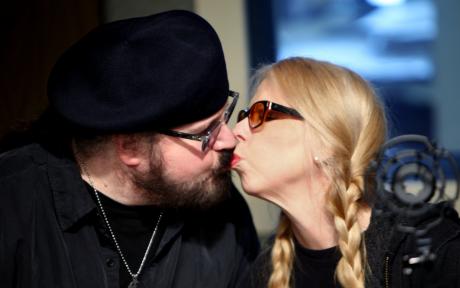
 Grayson Hugh & Polly Messer
In August, 2008 Hugh married his backup singer Polly Messer, Best Female Vocalist of CT (1981 - The Hartford Advocate), and former singer with the Connecticut swing band Eight To The Bar. Hugh's eagerly-awaited recording "An American Record", his first in fifteen years, was released on May 1, 2010, heralding a return to public eye and ear for this important American artist.

Wednesday, October 3, 2012

LRH aka L. Ron Hubbard


Lafayette Ronald Hubbard (1911 – 1986, better known as L. Ron Hubbard (and often referred to by his initials, LRH), was an American pulp fiction author and the founder of the Church of Scientology. After establishing a career as a writer, becoming best known for his science fiction and fantasy stories, he developed a self-help system called Dianetics which was first published in May 1950. He subsequently developed his ideas into a wide-ranging set of doctrines and rituals as part of a new religious movement that he called Scientology. His writings became the guiding texts for the Church of Scientology and a number of affiliated organizations that address such diverse topics as business administration, literacy and drug rehabilitation.
The Church of Scientology describes Hubbard in hagiographic terms, and he portrayed himself as a pioneering explorer, world traveller, and nuclear physicist with expertise in a wide range of disciplines, including photography, art, poetry, and philosophy. His critics have characterized him as a liar, a charlatan, and mentally unstable. Though many of his autobiographical statements have been proven to be fictitious, the Church rejects any suggestion that its account of Hubbard's life is not historical fact.
Personally, I don't know many people who look as bad with a beret as LRH...
Weird Jack and LRH performed the Babalon Working ritual along with Scarlet Woman, 
Marjorie Cameron, above. The goal of this ritual was to produce a satanic Moonchild

Tuesday, October 2, 2012

Chasseurs Alpins - Video's

Two video's related to the Chasseurs Alpins, both nicely showing their Tarte. 
This first video is of a proud daughter of a Chasseur and later Legionnaire, showing both berets. 
The second video is of the takeover of the Kapisi Region in Afghanistan by the Chasseurs Alpins from the  Régiment d'Infanterie de Marine. An interesting comparison between extremely small, and extremely large diameter berets. 

Monday, October 1, 2012

Made in China

Like it or not, most berets these days are made in China. Not the berets sold through South Pacific Berets, these are all made by traditional artisan manufacturers, but the many millions each year that are produced for the armies of the world.
I tried finding statistics about how many military personnel there are, on the planet, but failed - trust me, there are many too many and all of them get a new beret every 2 years or so... That makes for a huge industry. 
As a sideline, many of these factories also produce some Basque berets; easy, as a military beret is literally an amputated Basque beret (you can feel the point where the txortena (the "wick") had once been. 
On one of my internet searches, I came across the Majuyuan time-honored brand and found it too good to not post it here:
"As a China’s Time Honored Brand, Majuyuan was first set up in 1811 during Emperor Jiaqing’s reign of Qing Dynasty; it specialized in making hats for the royal family and officials. Because of the hats were beautifully made, with high quality and skillfully crafted, Majuyuan Hat Shop was praised the Head of Hat Industry in Beijing, and its hats have great fame and popularity among locals and visitors."
At $ 46.88 it is definitely not the cheap Chinese pricing. 

Sunday, September 30, 2012

Quick & Flupke


Quick & Flupke (Quick et Flupke in French) is a comic book series by Hergé (famous for The Adventures of Tintin) about two street urchins in Brussels named Quick and Flupke. The two boys unintentionally cause trouble, leading to annoyance with their parents and the police.
The series was published in black and white in the pages of Le Petit Vingtième starting in January 1930. The strips continued until 1940 (although they were republished in the Tintin magazine, conceived by Raymond Leblanc, this time coloured by Studios Hergé).
Hergé eventually abandoned the series in order to spend more time on The Adventures of Tintin, his more famous comic series. After Hergé's death, the books were coloured by the Studios Hergé and re-issued by the publishing house Casterman in 12 volumes, between 1985 and 1991.

Saturday, September 29, 2012

Brown - 2nd (French) Hussars

I don't often post on military berets, except when they are significantly 'different' or interesting for another reason (like the Tartes of the Chasseurs Alpin or Indian Naval Commandos).
These brown berets caught my eye because they don't have a badge attached to them, but the badge is embroidered on the beret. It's the badge of the French Tank Corps, with an added "portée hongroise" to it.  
The 2nd Regiment of Hussars is a French army regiment formed in 1735. The regiment distinguished itself during the Revolutionary and Napoleonic Wars.
Currently, it is the armoured regiment of intelligence to the Army. The regiment is part of the Intelligence Brigade stationed in Haguenau, which includes all the regiments of the "Earth Action Force" specialized in intelligence gathering.
The unit specializes in infiltration and camouflage, the 2nd Hussars are characterized by the mobility of its patrols that are re-deployable on short notice.