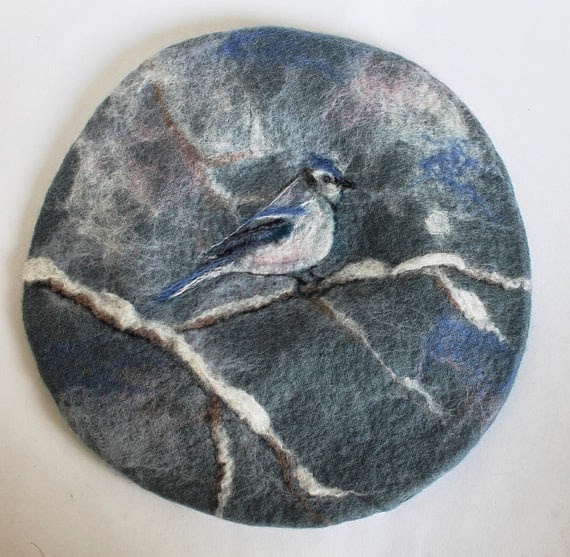
Monday, June 16, 2014

Baretwerpen

I have published on Lancer du beret or beret throwing, before, but little did I know that in my own native country this sport is well alive too!
The first Dutch National Championships "Baretwerpen" were held in April, 2013 at the Wyngaard Slavante ('Slavante Winery') in Maastricht. 
A superb location (very un-Dutch in this hilly landscape), good promotion for the beret you would think, but disturbingly few participants actually wore a beret...

Sunday, June 15, 2014

Jean/Hans Arp

Jean Arp / Hans Arp (1886 – 1966) was a German-French, or Alsatian, sculptor, painter, poet and abstract artist in other media such as torn and pasted paper.
When Arp spoke in German he referred to himself as "Hans", and when he spoke in French he referred to himself as "Jean". Many people believe that he was born Hans and later changed his name to Jean, but this is not the case.
Arp was a founding member of the Dada movement in Zürich in 1916. In 1920, as Hans Arp, along with Max Ernst, and the social activist Alfred Grünwald, he set up the Cologne Dada group. However, in 1925 his work also appeared in the first exhibition of the surrealist group at the Galérie Pierre in Paris.
In 1926, Arp moved to the Paris suburb of Meudon. In 1931, he broke with the Surrealist movement to found Abstraction-Création, working with the Paris-based group Abstraction-Création and the periodical, Transition. Beginning in the 1930s, the artist expanded his efforts from collage and bas-relief to include bronze and stone sculptures. He produced several small works made of multiple elements that the viewer could pick up, separate, and rearrange into new configurations.
Throughout the 1930s and until the end of his life, he wrote and published essays and poetry. In 1942, he fled from his home in Meudon to escape German occupation and lived in Zürich until the war ended.

Saturday, June 14, 2014

Visegrad

Both berets and Bosnia are very dear to my heart; I published on these before. 
Fourteen years ago on this date, June 14 1992, in Pioneer Street (Pionirska Ulica) in Visegrad around 60 Bosniak civilians, (women, children and elderly) were barricaded and burnt alive in a house. Almost all were from Koritnik village and a majority of them belonged to the Kurspahic family. Koritnik was looted and set ablaze.
Meho Aljic (middle), owner of the house where Bosniaks were burnt alive by Bosnian Serb soldiers in June 1992.
People crowded the site where Meho Aljic’s house once stood
Esad Tufekcic and other participants engage in a prayer for their loved ones, at the end of the ceremony. 

Friday, June 13, 2014

'Allo 'Allo!

Allo 'Allo! is a British sitcom broadcast on BBC1 from 1982 to 1992 comprising eighty-five episodes. The story is set in a small-town café in Nazi-occupied France during World War II. It is a parody of another BBC programme, the wartime drama Secret Army. 'Allo, 'Allo! was created by David Croft, who also wrote the theme music, and Jeremy Lloyd.
Set during World War II, 'Allo 'Allo! tells the story of René Artois, a French café owner in the town of Nouvion. The Axis military have occupied the town and stolen all of its valuable artefacts. These include a painting of The Fallen Madonna by Van Klomp (known to those who have seen it as The Fallen Madonna with the Big Boobies). 
Two officers, Colonel Erich Von Strohm and Captain Hans Geering, have decided to keep the paintings for themselves after the war, and they coerce René into hiding them in his café. Hitler also wants the paintings, and sends Herr Otto Flick of the Gestapo to the town to find them. Flick, in turn, 
conspires to keep them. The paintings are duplicated by a forger, get mixed up, lost, found and are put in knackwurst sausages, and hidden in the cellar of Café René.
Other valuable artefacts include a painting of the Cracked Vase with the big daisies by Van Gogh; the first cuckoo clock ever made; and some silver.
At the same time, the café is being used as a safe house for two brave but clueless British airmen, Fairfax and Carstairs. René is forced to work with the Resistance, led by Michelle Dubois, who threaten to shoot him for serving Germans in his café. The far-fetched plans of the Resistance to get the airmen back to England repeatedly fail. These are some of the main running gags of the series.

Thursday, June 12, 2014

The Cat's Cassoulet

From the classic nursery rhyme "Do not eat cassoulet, made by a French cat wearing a black beret".

Wednesday, June 11, 2014

Historical Caps

This is an authentic Scots Bonnet, made by Gloria Holmes of 'Historical Caps'. I was going to put together a post on Gloria's work, but much better than any writing by me, is her own reply to my message to her, pasted below (all other pictures from her web site):
Scots Bonnet with Saltire Badge to show allegiance to the Stewart King James IV
I have been a 17th century re-enactor in William Gordon's Regiment of Foote, a Regiment who fought under Montrose and supported King Charles I during the Wars of the Three Kingdoms, England, Scotland and Ireland in the 1640's. The Regiment is a member of the Sealed Knot Society.
Traditional Tam 'O' Shanter Bonnet
When I joined I noticed that there was a complete lack of good knitted headwear.  Most people in the Society sported cloth wool caps which were not totally authentic.  I found this strange as there was during the 16th/17th century a thriving industry in woolen caps, particularly hand knitted ones. Coming from Scotland myself, I surmised that with the weather being what it is, Scottish people would have worn knitted and heavily felted bonnets and caps as they were more practical and weatherproof.  I then started an investigation into the Blue Bonnet and found pictures of bonnets found in bogs or burials and could see that they were hand knitted and some retained their original colour.
Scots Bonnet with Saltire Badge to show allegiance to the Stewart King James IV
From this I studied the pictures and being a lifetime knitter I soon worked out the pattern and my bonnets were born.
I continued then to study other caps and hats from history and found I could produce them as well.
Statute Cap in Brown Herdwick
The history of the bonnet  is pretty vague.  It is thought that Scottish Mercenaries in Europe adopted the bonnet, which was then worn by clerics and scribes, and returned to Scotland with it. Why was is mainly blue?  It is thought that they used woad to dye the wool which in the early 16th was easy to come by as it was exported from France to Scotland and part of the trading link between that country and Scotland. This was part of the 'Auld Alliance' which had existed for centuries. The bonnets instantly marked soldiers as Scots when they raided the English border.
Full Brimmed Tudor (Statute) Cap
The bonnet was dyed in many colours by civilians and Scots used whatever plant was available in the Area. Gradually they added a Toorie ( Pom Pom) instead of the drawn in button top.  Over the decades the bonnet got smaller when adopted by Scots Regiments of the British Army and to this day thebonnet is still worn in various styles by the army.
Gloria in her studio
I have been running Historical Caps for the last 5 years.  I started selling to members of the Society. But now, since I created my website, I have been selling worldwide, to reenactors, museums, theatre and film companies.  I am still doing most of the spinning and knitting myself, but also buy ready spun wool, which I get dyed to colour I require.  I also have a lovely lady, who is a smashing knitter, to help me out as well at busy times.

Tuesday, June 10, 2014

Regenerating the Grasslands of Patagonia

The Savory Institute promotes large-scale restoration of the world’s grasslands through holistic management. Properly managed livestock is used to heal the land and others are empowered to do the same. The Savory Institute also removes barriers on the path to large-scale success through activities such as conducting research, creating market incentives and raising public awareness. 

OVIS 21 is the Argentine Hub of the Savory Institute. It´s role is to provide consulting, education and training services and support for the correct implementation of Holistic Management.
This partnership with Ovis 21, The Nature Conservancy and California based clothing company Patagonia, Inc. aims to restore natural grasslands across Patagonia through evolved grazing practices as defined by the Grassland Regeneration and Sustainability Standard (GRASS).
Thanks, John 

Monday, June 9, 2014

More Interesting Vintage Beret Pics from Australia

Melbourne Vic. 1941-03-15. Left to right: Aircraftwoman Margaret Miligan, Leslie Griffiths, Coral Clabburn on first recruit course at No 1 WAAAF Training Depot, Mayfield Avenue, Melbourne, wearing overalls and berets.
Portrait of a young East Timorese boy wearing a small gold kangaroo badge pinned to his brown beret. He is part of a crowd of locals who are watching the exhumation of bodies by an international crime scene investigation team. The human remains are those of East Timorese civilians who were massacred in the enclave in September 1999. Following the overwhelming vote for independence by the East Timorese on 30 August 1999 in the United Nations (UN) sponsored referendum, the pro-Indonesian militia launched a campaign of destruction, arson and murder, killing approximately 1500 people and forcing 300 000 others into West Timor as refugees. On 15 September, the UN issued a resolution, calling for a multinational force to restore peace and security and facilitate humanitarian assistance operations. By 20 September 1999, the first coalition force began deploying to East Timor as part of the Australian-led International Force for East Timor (INTERFET)..
Western Desert, Egypt. 11 November 1942. Portrait of Air Vice Marshal Arthur Coningham, Air Officer Commanding Western Desert (left, with his foot on a captured German petrol tin), and General B. L. Montgomery (wearing a beret), in conference at a headquarters. 
 A group of wireless telegraphists who worked at the Gawler Telecommunications Unit on the RAAF Base at Gawler. The unit was formerly known as Wireless Telegraphy Station. The women (WAAAF), some with beret, are gathered at a window of the galvanised iron hut that served as their living quarters.

Sunday, June 8, 2014

Berets in Wood

I first saw these wooden plates and boxes with a sculptered beret wearing man in Pau,  the capital of the French Bearn.
 Feeling sorry (and dumb) for not buying one as soon as I left Pau behind me, I started looking for these on the internet and found there is a whole range of wooden boxes with beret decorations.
Here are some of the pictures that I found. 

Saturday, June 7, 2014

Puro Instinct

Piper Kaplan is the lead singer of L.A. band Puro Instinct. Their albums are primarily downloadable from the WWW.
Sisters  Piper and (fellow band member) Skylar Kaplan.

Friday, June 6, 2014

Lagh Valley Scarves

Woollen scarves and berets - it seems a logical combination, but the reason why South Pacific Berets sells these scarves is a different one. These scarves are made by a one-family business in Suma, a small village in the Lagh Valley of Himachal Pradesh in the Indian Himalayas. Sushmana is the 17 year old daughter in the family of four and it is her dream to become a public health nurse in the local community. 
This means she will have to go to college in one of the larger cities which costs a small fortune. She will be the very first girl from the village to study further than high school, a goal very much supported by her lovely parents Shakuntala (mother) and Vishwanath (father). The small weaving business does not generate much money on the local market, but just from this first small batch of scarves that I bought at premium price, Susmana can study for over one term. 
South Pacific Berets' aim is not to make money from this new venture, but to support Sushmana in reaching her goal. It is my hope to extend the range of woven woollen fabrics made by Vishwanath and generate more money for his daughters studies and accommodation.
The wool used for these scarves is all local from the Lagh and Kullu Valleys, un-dyed and not chemically treated in any way. Only a small percentage of merino wool is added for the warp, to give more flexibility and strength to the woven product. The wool is hand-spun by Sushmana and woven by hand by Vishwanath. Not two scarves are identical, due to natural differences in the wool, the occasional tiny bit of hay in the wool.
The scarves measure 170 x 33 centimetres approximately and come in a dark brown and a melange of dark brown and cream. 

French Vintage Hand Carved Wood Bust of an Old Man with Beret

Vintage hand carved wood bust of an old man with beret; from France, 1950's.

Thursday, June 5, 2014

Interesting Vintage Material from Australia

Melbourne, Vic. 1943-07-06. The manager of the Allied Works Council Motor School addressing a class of supervisors, instructors and foremen. The men are wearing their new nut-brown uniform and beret, with shoulder badges to indicate their grading. The Civil Construction Corps badge is worn on the beret.
Major (Maj) Gray of the Salvation Army, points out something of interest outdoors, to an unidentified man in civilian clothing. Maj Gray is in uniform, including beret, and carrying his camera. He and his wife and daughter ran the Salvation Army's hut at the Hiro barracks, for the benefit of members of the 34th Infantry Brigade serving with the British Commonwealth Occupation Force (BCOF). Maj Gray later served in the Korean War.
Gaza. 1941-09. Middle East. Surf Life Saving Carnival at Gaza Beach. The 5th Division Cavalry Team lined up in their swimming trunks.
Point Piper, NSW,  1941. Members of the Women's Auxiliary Australian Air Force (WAAAF), dressed in overalls and berets, training.

Wednesday, June 4, 2014

2nd Commando Regiment beret bottle opener

A very Australian beret-related little device:
"A useful beverage accessory to remove the lid of twist top bottles, or to decorate your desk. Pewter coloured beret design with a small gold & black coloured 2nd Commando Regiment badge."
Yours for A$ 30.00.

Tuesday, June 3, 2014

Mirjana Gotovac's Berets

Following yesterday's post on Jannino's Art Berets, here are two samples of Mirjana Gotovac's.
Mirjana Gotovac was born in the rural countryside of Southern Croatia and moved to Canada some 28 years ago to start a new life with her husband and growing family. Ever since she was a little girl, she sought to express myself creatively through artwork which incorporates a large array of colours and textures. Her artwork incorporates different techniques and tools, from oils, to watercolours.
Mirjana is a self-taught fiber artist, and spends much of her time felting and creating new designs. My favourite technique is Nuno felting because it offers so many different texture and design possibilities that greatly enhance the richness of the product.
Find Mirjana's berets (and other works of art) here.