Wednesday, December 9, 2015

The Mystery of a Royal Navy Officer’s Beret

The mystery of a Royal Navy officer’s beret that washed ashore in a remote area of the west Highlands has been solved.
It belongs to Midshipman Shona Brown, of Glasgow, who lost her hat in Northern Ireland while aboard Faslane-based HMS Pursuer at the start of the summer.
Miss Brown is training to be a primary school teacher at Strathclyde University and belongs to the Glasgow and Strathclyde University Royal Navy Unit.
Royal Navy officer's beret washed up on north beach. By Dale Meegan

The 21-year-old was amazed when her commanding officer said it seemed her missing beret had reappeared  on a news website. 
And as any boinera, she was delighted when the woman who found it while taking her dog for a morning walk in Kilchoan on the Ardnamurchan peninsula in early September, agreed to post it back to her.

Tuesday, December 8, 2015

Cousin Itt

Cousin Itt is a fictional character in the Addams Family series. Unlike the other characters, Cousin Itt was not originally created by cartoonist Charles Addams, but by producer David Levy, though he did appear as an unnamed character in Addams's cartoons.
Itt Addams is the cousin of Gomez Addams. He is a short being whose entire body is shrouded by long hair. When Gomez asks Cousin Itt what is underneath all the hair, Cousin Itt replies, "Roots". His hair color changed throughout the years, but in the 1998 The New Addams Family TV series his hair color was blond. 
He usually wears sunglasses, a derby hat or beret, and gloves. He speaks in a high-pitched (with a slight British accent) gibberish language which the other members of the family can understand though it is incomprehensible to anyone else.

Monday, December 7, 2015

Robin Williams

Robin McLaurin Williams (1951 –2014) was an American actor and comedian. Starting as a stand-up comedian in San Francisco and Los Angeles in the mid-1970s, he is credited with leading San Francisco's comedy renaissance. After rising to fame as Mork in the sitcom Mork & Mindy (1978–82), he went on to establish a career in both stand-up comedy and feature film acting.
With Tom Cruise

After his film debut in the musical comedy Popeye (1980), he starred or co-starred in widely acclaimed films, including the comedy-drama The World According to Garp (1982), war comedy Good Morning, Vietnam (1987), dramas Dead Poets Society (1989) and Awakenings (1990), comedy-drama The Fisher King (1991), the animated musical-fantasy Aladdin (1992), drama Good Will Hunting (1997), and psychological thriller One Hour Photo (2002), as well as financial successes such as the fantasy adventure film Hook (1991), comedy Mrs. Doubtfire (1993), fantasy adventure Jumanji (1995), comedy The Birdcage (1996), and fantasy adventure-comedy Night at the Museum (2006).
Williams committed suicide on August 11, 2014, at his home in unincorporated Paradise Cay, California, at the age of 63.

Sunday, December 6, 2015

Diva

Thanks to a good arthouse video store, I managed to re-watch Diva, a French cult film that was an important part of my adolescent years. 
Diva is a 1981 French thriller film directed by Jean-Jacques Beineix, adapted from the novel Diva by Daniel Odier (under the pseudonym Delacorta). It is one of the first French films to let go of the realist mood of 1970s French cinema and return to a colourful, melodic style, later described as cinéma du look.
The film made a successful debut in France in 1981 and had success in the US the next year. The film became a cult classic and was internationally acclaimed.
When young messenger Jules (Frederic Andrei) makes an illegal recording of a famed opera singer's live performance he becomes inveigled in a madcap chase, pursued by a gang of Taiwanese music pirates and mistaken by a team of ruthless assassins. His life is turned upside down as he survives the thrills and spills of the unpredictable and unforgettable Parisian underworld.

An ingenious mix of comedy, romance and action DIVA is considered one of the most influential thrillers of the last twenty years. As stylish as ever DIVA remains a pivotal film that helped launche the Cinema Du Look movement and announce Beineix as a bold new talent in world cinema.
Two berets feature in the film (see these screen shots), one of the beautiful army veteran in the Parisian metro - you have to see the film to appreciate it. 

Saturday, December 5, 2015

Paul Bonatz

Paul Bonatz (6 December 1877 – 20 December 1956) was a German architect, member of the Stuttgart School and professor at the technical university in that city during part of World War II and from 1954 until his death.
1934
After the Nazis came to power he became architectural expert and advisor to Fritz Todt, the Nazi general inspector for German road building, and in this position built major bridges for the new Reichsautobahn system, but Bonatz was not a member of the Nazi party himself.
Bridge Köln-Rodenkirchen, 1939-41
The government tried to make good use of Bonatz's talents and name, but found him politically unreliable. Because of his vocal opinions, Bonatz was investigated twice by the police, who accused him of aiding Jews and being openly critical of Hitler. Although he won the competition to execute the gigantic glass dome for the new main station in Munich, he soon became disenchanted with Hitler's requiring the dome and critical of the entire design. This led him to leave Germany for Turkey in 1943.
Stuttgart Main Station, 1911-27

He returned to Germany in 1954 to participate in the reconstruction of Stuttgart and Düsseldorf. He was a professor at the University of Stuttgart from 1954 until his death in 1956.

Friday, December 4, 2015

Chi-Raq

Chi-Raq is a film directed by Spike Lee and written by Lee and Kevin Willmott. Set in Chicago, the film is described as a satire and to have as a subject gang violence prevalent in some neighborhoods on the city's south side, particularly, Englewood.
The film is based on Lysistrata, a Greek comedy by Aristophanes.
The film's title, a portmanteau of "Chicago" and "Iraq", has caused some controversy. Members of the Chicago City council and city residents have requested that Lee change the name of the film, worried about the image of their city, going as far as to threaten the tax credits that the film maker will receive from the city. 
"Chi-Raq" is a common endonym of residents of Chicago's South Side, used to describe the area as a war zone due to its high crime rates. Lee later called Chicago Mayor Rahm Emanuel a "bully" and several Chicago aldermen "bootlickers" for their criticisms.

More Americans have been murdered in Chicago in the last 15 years than have died in Iraq and Afghanistan combined. Much of the mayhem happens on the South and West sides. The black and brown sides. What they call Chiraq. In the racial mathematics of America, a black person is six times more likely to be the victim of a murder than a white person, and eight times more likely to be the murderer.
The film is clever, hysterical and a fresh take on a Greek comedy in a modern context. US gun laws and Americans' accessibility to firearms never fail to baffle non-Americans... 

Thursday, December 3, 2015

Ernst Reuter

Ernst Rudolf Johannes Reuter (1889 –1953) was the German mayor of West Berlin from 1948 to 1953, during the time of the Cold War.
Reuter opposed Kaiser Wilhelm's regime at the start of the First World War. After getting drafted, Reuter was wounded and captured by Russians during the Bolshevik Revolution. In captivity, Reuter joined the Bolsheviks and organized his fellow prisoners into a soviet. In 1917, Lenin sent him to Saratov in the to-be-established Volga German Autonomous Soviet Socialist Republic.
Upon his return to Germany, Reuter joined the Communist Party of Germany (KPD) and was named the First Secretary of its Berlin section. From 1931 until 1933, Reuter was the mayor of Magdeburg where he fought lack of housing and jobs due to the economic crisis. He also was elected as a member of the Reichstag. In 1933, with the Nazis now in power, he was forced to abdicate his positions and was brought to the concentration camp (KZ) Lichtenburg near Torgau. After his release, he went into exile in Turkey in 1935 where he stayed until the end to the Nazi era.
In 1947 he was elected Lord Mayor (Oberbürgermeister) of Berlin but in the deepening crisis of the Cold War, the Soviet government withheld their necessary consent. Reuter is most notable for his stance during the Cold War in Berlin. During the Soviet-imposed Berlin Blockade (1948/49), the western part of city was sustained by the Berlin airlift.
A few weeks after the uprising of 17 June 1953 in East Berlin, Reuter died suddenly and unexpectedly from a heart attack in West Berlin at the age of 64. His funeral was attended by more than 1 million people.
Reuters was buried with his (Codeba) beret, pictured here on top of his coffin. 

Wednesday, December 2, 2015

Josef Ackerl

Josef Ackerl (1946) is a former Austrian politician for the (SPÖ).
From Chairman of the Socialist Youth of Austria (1976 – ‘78), he became a member of the Linz City Council  and moved on to membership of the Upper Austrian Provincial Government (till 2014).

On October 1, 2013 Josef Ackerl called the new boss of Team Stronach (a Eurosceptic and right-wing populist political party in Austria), Kathrin Nachbaur, a "bimbo" in a Facebook entry and thus triggered a new debate on sexism in Austrian politics.

Tuesday, December 1, 2015

Poilus

Poilu is an informal term for a French World War I infantryman, meaning, literally, hairy one. The term came into popular usage in France during the era of Napoleon and his massive citizen armies, though the term grognard (grumbler) was also common. It is still widely used as a term of endearment for the French infantry of World War I. The word carries the sense of the infantryman's typically rustic, agricultural background. Beards and bushy moustaches were often worn. The poilu was particularly known for his love of pinard, his ration of cheap wine.
The image of the dogged, bearded French soldier was widely used in propaganda and war memorials. The stereotype of the Poilu was of bravery and endurance, but not always of unquestioning obedience. 
At the disastrous Chemin des Dames offensive of 1917 under General Robert Nivelle, they were said to have gone into no man's land making baa'ing noises — a collective bit of gallows humor signaling the idea that they were being sent as lambs to the slaughter. 
Outstanding for its mixture of horror and heroism, this spectacle proved a sobering one. As the news of it spread, the French high command soon found itself coping with a widespread mutiny. A minor revolution was averted only with the promise of an end to the costly offensive.
Needless to say, many Poilu's were the Tarte wearers of the Chasseurs Alpins!

Monday, November 30, 2015

East German Patent

A beret-wearing representative of the Office for Inventions and Patents of the GDR has the Magdeburg motorist Otto Tüpke granted for a patent under number 3269 for a device for better utilization of petrol. 
25 November, 1952.

Sunday, November 29, 2015

Red Cross Berets

Red Cross Soviet Union during WWII
Canadian Red Cross, WWII
Medical Officer (rank of Captain) of the Canadian Red Cross
Cotton beret of the French Red Cross, WWII, made in Paris
Wool beret of the French Red Cross, WWII
Wool beret French red Cross, post WWII

Saturday, November 28, 2015

Pedro Fernandez de Unamuno

I found the article below in the Huffington Post; an article by Nancy A. Ruhling and I received her kind permission to re-publish it here in full. Thank you Nancy - it's a beautiful story!

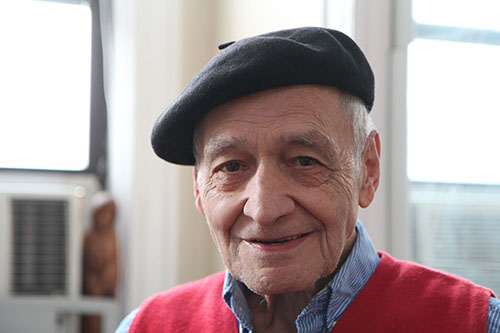
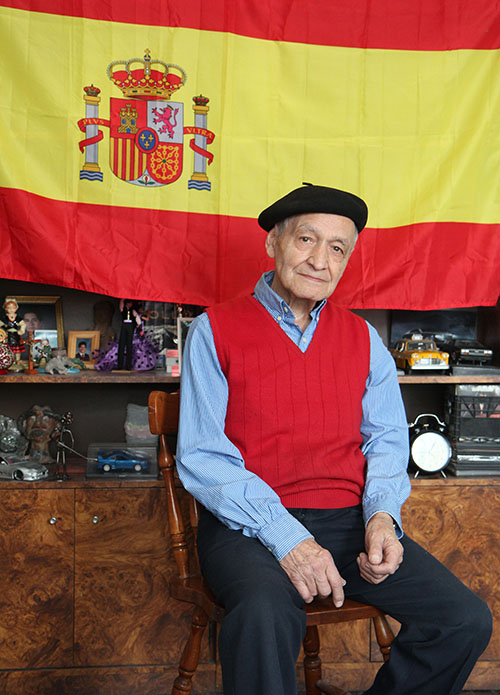
If you don't know anything about Pedro Fernandez de Unamuno, and most of the world doesn't, look at his hat.
He's wearing it so you'll ask him about it.

Ask Pedro about his Boina.
It's a black Boina, a Basque-style beret that he sets rakishly atop of what's left of his wispy white hair.
It, and the Spanish flag unfurled across the living room bookcase like a banquet banner, remind him of the homeland he was forced to flee.
Pedro, an Old World charmer who kisses visitors on each cheek, can tell you the story in your choice of English, Spanish or French.

Pedro is from Santander, Spain.
A student of history and philosophy who plays Beethoven and Chopin on a Yamaha keyboard in his idle hours, Pedro stands tall (officially, he's 5-foot-5, an inch shorter than Napoleon) during his recitation.
"I may be small," he says, adding that age has shaved off a handful of those inches, "but I am great."
It starts with his role, or more accurately, his non-role, in the Spanish Civil War.

The flag reminds him of home.
Pedro and his family were living in the Basque Country's city of Santander, which, long before Pedro's time, was the main seaport for the Old Castile in the Bay of Biscay.
In 1938, when la guerra was raging, it was not a safe place to be, especially when your father was fighting for the Republic, the losing side.
His mother was sent to a concentration camp in France, and 5-year-old Pedro, his older brother and two sisters were among thousands of children relocated to various countries by the International Office of Refugees.

Pedro likes to draw; this work is from 1966.
Pedro and his siblings were transported by truck to Brussels, Belgium, where they were summarily separated.
"It was traumatic for me because I was so little," Pedro says. "I cried a lot."
Pedro was adopted by Jean Fonteyne, a prominent lawyer, communist politician and resistance fighter.
By the time the Civil War had ended with victory for Francisco Franco's fascists, World War II had begun, and Pedro didn't get an opportunity to return to Spain for a dozen years.
At 5, he was sent to Belgium as a refugee.
"The country was in terrible shape," he says. "There were hunger, terror, executions and mass jailings. And I couldn't speak Spanish to communicate with my parents; I only knew French."
He returned to Belgium, where his future was just as bleak.
"The government required me to work in a coal mine," he says. "After a couple of months, I decided that it would be better to be alive, in misery, above ground than to die below, so I went back to Spain."

The Franco government declared him an enemy.
There, because of his relationship with Fonteyne, Pedro was placed under police surveillance.
"They suspected me of having a secret mission because of him," Pedro says. "They followed me for years, and the government issued me the ID number 3939393939, which I found out after I left was the classification for an enemy."
After serving a mandatory stint in the military, Pedro got work in a machine shop.
"Through all of this, I was a survivor," he says. "I used psychology as a weapon."

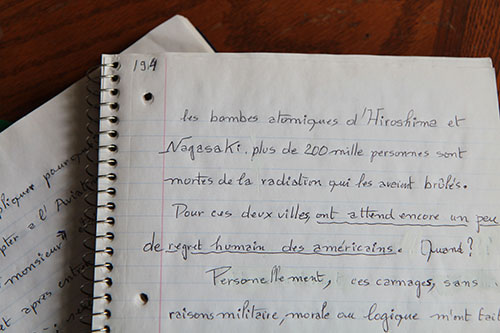
The manuscript for Mes Trains de Nuit.
A chance encounter on a train brought him to New York City.
"I met a French lady who was a translator for the United Nations," he says. "She then became my wife."
With her help, Pedro got a job with the Tunisian consul.
"But I wanted to work for an American company," he says. "I didn't know any English, so I took a course at Hunter College."
He came to NYC in his 20s.
It worked: Pedro got a job with Kerns Manufacturing Corp., the Long Island City-based maker of aerospace products.
As the decades unfolded, Pedro became a company supervisor, and his personal life took some unexpected turns.
He would take three more wives (Nos. 1, 2 and 3 succumbed to divorce, and Mrs. No. 4 is 20 years Pedro's junior) and produce four children.
His one constant, his Kerns job, ended a couple of years ago, when he was in his late 70s.
'I may be small, but I am great.'
"I was laid off because there was not enough money to keep me," the 82-year-old says sadly. "I'm healthy. I could have kept working. I would like to work part time, but nobody will hire a man my age."
Pedro didn't know what he was going to do with all his free time, so he started writing the story of his life.
His autobiography, Mes Trains de Nuit (My Night Trains), ends with Pedro's arrival in New York City at age 24.
The 450 hand-written pages are in French, the language Pedro feels most comfortable with. They fill five large-format spiral notebooks; one of his sons is typing the text for publication.
"It was therapeutic," he says. "I wanted to leave something behind for my children to remember me, and I didn't want what I went through to be lost. I stopped the story at age 24 because I had a good, normal life here."

Pedro, wistful for the life he might have lived.
The life he lived in America is the one he wishes he had in Spain. It pains him to think of what might have been.
"It would have been better to be united with my family," he says. "We would have suffered, but we would have suffered together."
He used to visit Spain a lot, but he hasn't been in a long time, which is what a couple of years seems like to him.
His Social Security and pension, which are all he has, don't cover the cost.
Pedro sighs and sets the Boina aside.

Nancy A. Ruhling may be reached at Nruhling@gmail.com, nruhling on Instagram.
All photos by Nancy A. Ruhling

Friday, November 27, 2015

Floreano

Floreano is a good-natured, witty comic character from Galicia (Spain). He enjoys good conversations with friends. 
Floreano wears a beret, or boina, permanently. His best friend, and fellow boinero, is Epi, but there are many more characters wearing berets in his adventures. 
Floreano is married to Monchiña, a down-to-earth woman famous for her rural cuisine and ability to throw objects long distance. 
Famous in certain circles, Floreano features on wine labels and also has his own table at a cafe in Vigo.