Monday, April 17, 2017

Vlado Perlemuter

Vlado Perlemuter (1904 –2002) was a Lithuanian-born French pianist and teacher.
Born to a Polish family in Kovno (now Kaunas in Lithuania), the family settled in France in 1907. In 1915, aged just 10, he was accepted by the Paris Conservatoire. At 15, he graduated from the Conservatoire, where he won the First Prize playing Gabriel Fauré’s Thème et variations before the composer, although Fauré was already deaf by that time.
In 1925 Perlemuter heard Jeux d'eau for the first time, and then he decided to study all the music of Maurice Ravel. In 1927 a friend of Perlemuter suggested him to send Ravel a letter to ask for coaching of his works. Ravel agreed and Perlemuter studied all of Ravel's solo works for piano with the composer himself for a period of six months at his home in Montfort l'Amaury.
As a Jew he was in danger in Nazi-occupied France, and was hunted by the Gestapo, barely managing to escape to Switzerland, where he lived until 1949. In 1951 he joined the teaching staff of the Paris Conservatoire.

His final years compromised by memory loss and failing sight, he died at the American Hospital in Paris in 2002 at the age of 98.

Sunday, April 16, 2017

Laurita Siles from Fundación BilbaoArte Fundazioa

If only my Spanish, let alone Basque, language skills were better, I could relate here exactly what these photographers stand for. Alas, neither Spanish or Basque or my strong points.
The pictures were found on this website and I understand it is about an art project of Laurita Siles that celebrates the peasant life; a bicycle carding wool, for example.
The blackened face has to do with the carranzanas sheep; a breed at the edge of extinction.
Either way, fascinating pictures. 

Saturday, April 15, 2017

Johan van Hell

Johannes "Johan" Gerardus Diederik van Hell (1889 –1952) was a Dutch visual artist and musician. He was a dedicated socialist and a man with a highly developed social conscience. Many of his later works depict the struggles and plight of ‘the man in the street’. In 1925, he decided to produce lithographs to make art available at a reasonable price to the working class. He also gave free private art and music lessons to gifted students who could not afford the tuition.
 
His art oeuvre is varied, ranging from oil paintings, water colours, wood cuts and lithographs to political posters, ex-libris and magazine and book covers and illustrations. He also received regular commissions from the City of Amsterdam for monumental art. His music was at least as important to him as his art. His instrument was the clarinet but he also played the oboe. He regularly performed with Amsterdam’s Concertgebouw Orchestra but refused a permanent position. In his last years his music took precedence over his art.

Friday, April 14, 2017

Willie G. Davidson

William Godfrey "Willie G." Davidson (1933) is an American businessman and motorcycle designer, and the former senior vice president & chief styling officer of Harley-Davidson Motor Company.
He was also the head of Harley-Davidson's Willie G. Davidson Product Development Center in Wauwatosa, Wisconsin. While being generally responsible for approving Harley-Davidson motorcycle designs, he also personally designed several motorcycles for Harley-Davidson, including the Super Glide and the Low Rider, which pioneered the factory custom motorcycle and created an intermediate line of motorcycles between their large touring models and their smaller Sportsters.
Willie G. Davidson is the son of former Harley-Davidson president William H. Davidson and the grandson of Harley-Davidson co-founder William A. Davidson. Consequently, he grew up around Harley-Davidsons. Davidson graduated from the University of Wisconsin–Madison and went on to study at the Art Center College of Design in Pasadena, California, where he became aware of bike customization.
Before working for Harley-Davidson, Davidson worked for the design department of Ford Motor Company. Willie G. retired from Harley-Davidson in 2012. He is to remain involved as brand ambassador and in Special Design Projects as Chief Styling Officer Emeritus.

Thursday, April 13, 2017

Vintage Beret Advertising

Decal for Pébéo berets (made by Blancq-Olibet); "The Ace of Basque Berets"
An old decal for Boinas Elósegui berets. The same man features on present day Boinas Elósegui advertising.
Le Béret Chic: el Ramuntcho, "King of the Basque Country".
Kangol; capture the '30s look in the 1970s

Wednesday, April 12, 2017

Felix Urabayen Guindo

Felix Urabayen Guindo (1883 - 1943) was a scarcely known  writer, novelist and narrator; now seen as one of the best prose writers of the literary generation of pre-Spanish Civil War.
He was the most prominent figure of the Navarre narrative and the first third of the twentieth century. Formerly a teacher, his friendship with Manuel Azana led him to stand for election in 1936 and got the post of Minister of Culture.
After the Francoist uprising, he had to move to Madrid and took refuge in the Mexican Embassy. He was arrested and jailed until November 1940. The last two years of his life were spent in Pamplona, where he finished his Under the Navarran Oak , the work that would close his Basque - Navarrese tetralogy.

Tuesday, April 11, 2017

T. C. Boyle

Thomas Coraghessan Boyle, typically known as T. C. Boyle (1948), is an American novelist and short story writer. Since the mid-1970s, he has published fourteen novels and more than 100 short stories. He won the PEN/Faulkner award in 1988, for his third novel, World's End, which recounts 300 years in upstate New York.


He is a Distinguished Professor of English at the University of Southern California.


In Understanding T. C. Boyle, Paul William Gleason writes, "Boyle's stories and novels take the best elements of Carver's minimalism, Barth's postmodern extravaganzas, Garcia Marquez's magical realism, O'Connor's dark comedy and moral seriousness, and Dicken's entertaining and strange plots and brings them to bear on American life in an accessible, subversive, and inventive way".


Many of Boyle's novels and short stories explore the baby boom generation, its appetites, joys, and addictions. His themes, such as the often-misguided efforts of the male hero and the slick appeal of the anti-hero, appear alongside brutal satire, humor, and magical realism. His fiction also explores the ruthlessness and the unpredictability of nature and the toll human society unwittingly takes on the environment. 

His short stories regularly appear in the major American magazines, including The New Yorker, Harper's, Esquire, The Atlantic Monthly and Playboy, as well as on the radio show, Selected Shorts.

Monday, April 10, 2017

Kelly Lynn Hamilton

Kelly Hamilton was born in Miami, Florida and began studying dance at age 4. At 14 she was accepted into the prestigious New World School of the Arts. After studying at Florida State University, she graduated with a master’s degree in dance and begins to travel the world as a model for L'Oreal.
Her career took firm steps on stage in Las Vegas, but has also participated in numerous advertising campaigns for companies such as L’Oréal, Heineken and the World Tour of Poker. 
All that experience in front of cameras facilitates the task of the photographer, and his play with the gaucho look gives unique postcards. A silver facón, a beret, bolas, leather belt, are integrated in the production.


Sunday, April 9, 2017

Meet Marcus Doucette

Meet (friend & beret customer) Marcus Doucette!
Marcus is a DJ at Radio Milwaukee 88Nine, specialized in World Music, but apart from that, also a father, yogi, incense aficionado and obsessed with the rare and obscure.
I don't know how The Beret Project scores on the Obscurity Index, but Marcus certainly has an eye for rare quality, choosing Aurloronesa and Aotearoa berets! He is definitely the Nr.1 advocate for berets in Milwaukee and far surroundings. 
Pictured here at a NZ beach and in front of the Govette-Brewster Art Gallery on a visit to New Zealand, after coffee at Beret HQ.

Saturday, April 8, 2017

The Spirit of the Beehive (El espíritu de la colmena)

The Spirit of the Beehive (El espíritu de la colmena) is a 1973 Spanish drama film directed by Víctor Erice. The film was Erice's debut and is considered a masterpiece of Spanish cinema.
Six-year-old Ana lives in the manor house in an isolated Spanish village on the Castilian plateau with her parents Fernando and Teresa and her older sister, Isabel. The year is 1940, and the civil war has just ended with the Francoist victory over the Republican forces. Her aging father spends most of his time absorbed in tending to and writing about his beehives; her much younger mother is caught up in daydreams about a distant lover, to whom she writes letters. The entire family is only ever seen together in a single shot towards the end of the movie, there is no discussion. Ana's closest companion is Isabel, who loves her but cannot resist playing on her little sister's gullibility.
At the beginning of the film, a mobile cinema brings Frankenstein to the village and the two sisters go to see it. Ana finds the film more interesting than frightening; particularly the scene where the monster plays benignly with a little girl, then accidentally kills her. She asks her sister, "Why did he kill the girl, and why did they kill him after that?" Isabel tells her that the monster didn't kill the girl and isn't really dead; she says that everything in films is fake. Isabel says the monster is like a spirit, and Ana can talk to him if she closes her eyes and calls him: "It's me, Ana."
At the end of the film, Ana recalls what Isabel said about calling the monster, and she stands alone by her bedroom window and closes her eyes.
The film is full of hidden meanings. The disintegration of the family's emotional life is symbolic of the emotional disintegration of the Spanish nation during the civil war.
The barren empty landscape around the sheepfold represents Spain's isolation during the beginning years of the Francoist regime.
The film was made in 1973, when the regime was not as severe as it had been at the beginning; however it was still not possible to be openly critical of the regime. By making films rich in symbolism and subtlety, a message could be embodied in a film that would be accepted or missed by the censor's office.

Friday, April 7, 2017

Military Atheists and Secular Humanists (MASH)

When researching material for new posts, I came upon this NBC News article on atheists in the US Army. 
I have often been surprised by the large role of the church in US society (and politics), but to read that only 4% of the US Military is formed by humanists, agnostics and atheists I found truly astonishing, let alone their struggle to be recognized as "none Christians". 
In the Dutch armed forces, Humanist counsellors are appointed as civil servants not commissioned officers. For carrying out their work they are viewed equivalent to the military ranks (captain, major or lieutenant colonel). They are employed in the military, not by the military, and work outside the military hierarchy. Professionally they are not accountable to the Ministry of Defence or the military authority, but to the agency that sends them, in our case the Dutch Humanist Society (Humanistisch Verbond). 
Lt.Col. de Kooter, Humanist Counselor 
Chaplains are not formally subject to the orders of the military commanders. This service exists primarily for the people as individuals, not for the military apparatus. Humanist counselors thus like to call themselves “critically involved” (in a good way).
Beret badge Humanist Councillors 
Being unlucky to be part of the 25% or so that got drafted into the military (in 1982), I became the secretary of one of these counsellors; the best part of 14 months of military service!

Thursday, April 6, 2017

Mr Arkadin

Mr. Arkadin (first released in Spain, 1955), known in Britain as Confidential Report, is a French-Spanish-Swiss coproduction film, written and directed by Orson Welles and shot in several Spanish locations, including Costa Brava, Segovia, Valladolid and Madrid. Filming took place throughout Europe in 1954, and scenes shot outside Spain include locations in London, Munich, Paris, the French Riviera, and the Château de Chillon in Switzerland.
Many berets in this short video clip. 

Wednesday, April 5, 2017

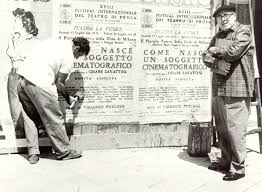
Cesare Zavattini

Cesare Zavattini was an Italian screenwriter and one of the first theorists and proponents of the Neorealist movement in Italian cinema.
Born in Luzzara, near Reggio Emilia in northern Italy in 1902, Zavattini studied law at the University of Parma, but devoted himself to writing. In 1930 he relocated to Milan, and worked for the book and magazine publisher Angelo Rizzoli.
After Rizzoli began producing films in 1934, Zavattini received his first screenplay and story credits in 1936. In 1935, he met Vittorio De Sica, beginning a partnership that produced some twenty films, including such masterpieces of Italian neorealism
In his only experience in Hollywood, Zavattini wrote the screenplay for The Children of Sanchez (1978) based on Oscar Lewis’s book of the same title, a classic study of a Mexican family. 
At the 11th Moscow International Film Festival in 1979, he was awarded the Honourable Prize for the contribution to cinema. In 1983 he was a member of the jury at the 13th Moscow International Film Festival.
Zavattini died in Rome on 13 October 1989. He was an atheist.

Tuesday, April 4, 2017

Rust

Rust is an iron oxide, usually red oxide formed by the redox reaction of iron and oxygen in the presence of water or air moisture.
Given sufficient time, oxygen, and water, any iron mass will eventually convert entirely to rust and disintegrate. Surface rust is flaky and friable, and it provides no protection to the underlying iron, unlike the formation of patina on copper surfaces.
Personally, I love rust! Not just the colour, but also the layered texture of rust, the immensity of variations in colour and shine.
Living in Wellington (island climate, lots of moisture and salt in the air) is a treasure trove for rust and, although I am happy not to see it on my car and roof, I can really enjoy the many arrived patches of rust by simply going out for a walk through the neighborhood.
Needless to say, the colour rust-red (or burnt sienna, rusty brown, terracotta, etc) is one of my favourites when it comes to berets. It used to be available only under the Auloronesa and Aotearoa labels, but Boinas Elosegui now custom made me a burnt-sienna Super Lujo model too.


Monday, April 3, 2017

The Right to Arm Bears

The link to The Right to Arm Bears was sent to me after the April 1 post on Donald Trumps "beret ban" by customer and friend Bill. 
In Bill's words: "Maybe you should consider sending your berets wrapped around a firearm. We take our Free Dumbs seriously over here in Trumplandia. Customs should respect the right to arm bears, especially if they're Russian".
For those who, like me, are not familiar with The Right to Arm Bears, it is a collection of Gordon R. Dickson's three science fiction novellas that occur on the planet Dilbia, where humans and an alien race known as Hemnoids are trying to win the support of the native bear-like population.
And yes, the Bears do wear berets!

Sunday, April 2, 2017

Gudaris

Many berets feature in this historic video of gudaris (Basque fighters), defending the Spanish Republic during the Civil War. 

Saturday, April 1, 2017

Not an April Fools Day Joke

Usually, on the 1st of April, you would read an interesting story here pulling your boinero's leg, like on Cuba levying copyright fees on Ché Guevara merchandise; about US sheriffs having to change from Stetson hats to berets; Tarte Chasseurs for James Bond and the like (see here to refresh your memory: 2016, 2015, 2014, 2013).
This year I had a few ideas for interesting stories lined up, but since Donald Trump's decree of 28 March, one idea became obsolete and really, who needs an April Fools day joke when the reality is this funny outrageous? 
For those outside the US who missed the announcement (and American boineros who failed to understand the implications of decree #131, or the Importation of Foreign Manufactured Goods Act, appendix 12F, ref's. CDE), this simply means that from 1 May 2017 no Basque berets can be imported into the United States without a certificate issued by the US Custom Department  stating that no equivalent can be found or made within the territory of the United States of America.
So? Yes, there are berets made in the US (Parkhurst, New York for example; Bancroft) and therefore, no more French, Spanish, Italian and South American made beret will make it to US shores without being taxed at 280% of sales value (and added US Customs fee at $82.00/shipment) - effectively banning foreign berets.
What that means for South Pacific Berets with some 60% of customers in the US? I dread to even think about it... I spoke to the people at Laulhère this morning who believe they can bypass the ruling by opening a webshop based inside the US...
It'l become very hard to Make America Great Again.