
Thursday, December 12, 2013
1937 Boinas Elósegui Ad


Wednesday, December 11, 2013
Béret et Casquette
.jpg)


Tuesday, December 10, 2013
Yves Coppens
Yves Coppens (1934, Morbihan) is a French anthropologist. He graduated from the University of Rennes. He has studied ancient hominids and has had multiple published works on this topic, and has also produced a film.


Yves Coppens visits the Laulhere factory in Oloron Sainte Marie
Coppens is one of the co-discoverers of Lucy along with Donald Johanson and Maurice Taieb, although Richard Dawkins makes the following observation in The Ancestor's Tale: "Incidentally, I don't know what to make of the fact that in his native France, Yves Coppens is widely cited as the discoverer of Lucy, even as the 'father' of Lucy. In the English-speaking world, this important discovery is universally attributed to Donald Johanson." This confusion covers the fact that that Coppens was the director of the Hadar expedition and so responsible for the all of the expedition's finds, whereas Donald Johanson was participant in the expedition and the one to actually chance on Lucy's skeleton.
Laulhere director René Renda with Yves Coppens
The "Rift Valley theory", proposed and supported by the Dutch primatologist Adriaan Kortlandt, became better known when it was later espoused and renamed by Coppens as the "East Side Story". However this paradigm has been challenged by the discovery by Michel Brunet' s team of Australopithecus bahrelghazali (Abel) and Sahelanthropus tchadensis (Toumaï) in Chad (2 500 km to west rift walley. The asteroid 172850 Coppens is named in his honour.
Monday, December 9, 2013
Conrad Felixmüller
Conrad Felixmüller (21 May 1897 – 24 March 1977) was a German expressionist painter. Born in Dresden as Conrad Felix Müller, he chose Felixmüller as his nom d'artiste.
 One of the youngest members of the New Objectivity movement, Felixmüller was also a member of the Communist Party of Germany. His paintings often deal with the social realities of Germany's Weimar Republic. He was mentor to German expressionist, Otto Dix. From 1949 to 1962 he taught at the University of Halle. He died in the Berlin suburb of Zehlendorf.
Sunday, December 8, 2013
Bargains at South Pacific Berets!
A stock take and tidy up at South Pacific Berets resulted in a few good bargains in specific sizes.

Lucky those who share my size 59! I have a number of size 59 Bérets Bakarra in 10.5 pouces (29cm) and Bérets Bakarra DeLuxe in 9.5 pouces (267mm) in stock still. Somehow, I miscalculated when ordering these berets last year and got far too many in size 59. These models won't be re-stocked and these two labels are the very last available.Top quality berets in their range; the Bakarra one of the best medium range berets and the DeLuxe among the best berets Blancq-Olibet makes. Only in size 59, at a bargain price of $ 55.00 and $ 62.50 respectively.

The Béret Berrueta is made especially for outdoors enthusiasts and hunters - a 10 or 10.5pouces (28 or 29cm) beret in loden-green with it's own embroidered Berrueta label. A hard to find beret, even in France. These berets come in Blancq-Olibets 565 quality range. This is the same beret as used by the officers of the Belgian military regiment of Chasseurs Ardennais.

All available here, in the One-Off-Section!
Ramon Sender Barayón
Ramon Sender Barayón (1934, Madrid, Spain) is a composer, visual artist and writer. He was the co-founder, with Morton Subotnick of the San Francisco Tape Music Center in 1962.
 In January, 1966, he co-produced the Trips Festival, with Ken Kesey and Stewart Brand, a three-day event that, in conjunction with The Merry Pranksters, brought together the nascent hippie movement for the first time.
 Sender is also a visual artist whose visual works are sampled on his web site and in a book, "Barayon", a Catalog of Prints, Drawings, Original Art by Ramon Sender Barayon, 2009. The book is based on a one man show at the Gallery Sanchez in 2008.
 After the death of Sender’s daughter ‘Xavie’ in 1989, he founded the Peregrine Foundation (for people "living in or exiting from experimental social groups"). He was the administrator of the foundation until 1999.
Sender identifies himself as a "transcendental, post-monotheist hippie pagan sunworshipper, with one foot planted in the nondual teaching of Candice O'Denver and the other in the Archaic Revival culture"


Sender identifies himself as a "transcendental, post-monotheist hippie pagan sunworshipper, with one foot planted in the nondual teaching of Candice O'Denver and the other in the Archaic Revival culture"
Saturday, December 7, 2013
Ilja Gort


Friday, December 6, 2013
Mademoiselle Marie


Thursday, December 5, 2013
Wednesday, December 4, 2013
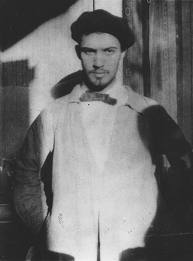
Amadeo de Souza, con boina
Amadeo de Souza Cardoso (1887 – 1918) was a Portuguese artist.
 Amadeo was born in Mancelos, a parish of Amarante. At the age of 18, he entered the Superior School of Fine Arts of Lisbon and one year later (on his 19th birthday) he went to Paris, where he intended to continue his studies but soon quit the architecture course and started studying painting. By then, he was especially experienced in caricatures.
 In 1913, Amadeo de Souza Cardoso participated in two seminal exhibitions: the Armory Show in the USA, that travelled to New York City, Boston, and Chicago, and the Erste Deutsche Herbstsalon at the Galerie Der Sturm in Berlin, Germany, directed by Herwarth Walden. Both exhibitions presented modern art to a public that was still not used to it.
 In 1925, a retrospective exhibition in France of the painter’s artwork was well received by the public and critics. Ten years later in Portugal, an award was created to distinguish modern painters: the Souza-Cardoso prize.


Tuesday, December 3, 2013
Blaise Cendrars, always with Beret


He died in 1961.
Monday, December 2, 2013
Joaquim Pereira Teixeira, con boina
Joaquim Pereira Teixeira de Vasconcelos (2 November 1877, Amarante Municipality, Portugal - 14 December 1952, Gatão, Portugal), better known by his pen name Teixeira de Pascoaes, was a Portuguese poet.
 Teixeira has been nominated five times for the Nobel Prize in Literature.
.png)

.png)
Sunday, December 1, 2013
António Alves Redol, con boina
António Alves Redol (1911 - 1969) was one of the most influential Portuguese neorealist writers.
Redol was born in Vila Franca de Xira and, at the age of 15 he started publishing articles in the local weekly newspaper Vida Ribatejana. In 1928 Redol travelled to Angola (a Portuguese colony at the time), where he stayed for three years. His stay in Angola was mainly unfruitful but influenced his world view, which later became visible in his literature.
 In 1936 Redol publishes his first collaboration with O Diabo, the short story Kangondo, set in an African ambiance. He will continue writing chronicles and tales, identifying himself with the social issues of his region, Ribatejo.
Redol got involved the agricultural workers, like the workers in the rice fields near the Tagus river, and listened to their stories and experiences.
 In the beginning of the 1940s he joins the Portuguese Communist Party, which was then illegal. Alves Redol is arrested in May 1944, but in November 1945 he participates in the Central Committee of the Movement of Democratic Unity (Movimento de Unidade Democrática (M.U.D.)) for which he actively participates in the campaigns for the fake elections held by the Salazar regime.
 In 1947 he is nominated Secretary-General of the Portuguese section of the International PEN. In 1948 he participates in the World Congress of Intellectuals for Peace, in Wrocław, Poland.
 His novel Horizonte Cerrado (1948) is the first volume of a trilogy concerning the Portuguese winemaking region of Douro. Os Homens e as Sombras (1951) and Vindima de Sangue (1953) complete the so-called Portuguese wine cicle.
 A Barca dos Sete Lemes was translated into the English language by Linton Lomas Barrett and published as A Man with Seven Names by Knopf in 1964.
Alves Redol died in Lisbon, in 1969.

Redol was born in Vila Franca de Xira and, at the age of 15 he started publishing articles in the local weekly newspaper Vida Ribatejana. In 1928 Redol travelled to Angola (a Portuguese colony at the time), where he stayed for three years. His stay in Angola was mainly unfruitful but influenced his world view, which later became visible in his literature.

Redol got involved the agricultural workers, like the workers in the rice fields near the Tagus river, and listened to their stories and experiences.

Alves Redol died in Lisbon, in 1969.

Redol's statue, that caused an outcry when unveiled - apart from his beret, he is nude (though you're never really nude with a beret on your head...)
Saturday, November 30, 2013
Painter Jarji Balanchivadze
,+nephew+of+the+Georgian+choreographer+Balanchine.+georgia+2009.jpg)
His apartment has not changed since the days when Stravinsky and Shostakovich used to meet there.
Friday, November 29, 2013
Benedict Joseph Groeschel, with Beret
Benedict Joseph Groeschel, C.F.R. (born July 23, 1933) is a Catholic priest, retreat master, author, psychologist, activist and former host of the television talk program Sunday Night Prime, which is broadcast on the Eternal Word Television Network. He has also hosted several serial religious specials in addition to Sunday Night Prime. He is the founder of the Office for Spiritual Development for the Catholic Archdiocese of New York as well as a former associate director of Trinity Retreat and a former executive director of the St. Francis House. He is professor of pastoral psychology at St. Joseph's Seminary in New York and an adjunct professor at the Institute for Psychological Sciences in Arlington, Virginia. He is one of the founders of the Franciscan Friars of the Renewal.
 In 1960, Groeschel became the chaplain for the Children’s Village, a Dobbs Ferry, New York based facility for emotionally disturbed children. In 1965, he joined the staff of St. Joseph's Seminary and has taught classes at Fordham University, Iona College and Maryknoll Seminary. In 1967, he founded The St. Francis House in Brooklyn, New York, which provides a safe haven for young men looking for a new start in life. The results of his counseling, teaching ability and the manner in which he treated his subjects attracted the attention of many, including Terence Cooke, then Archbishop of New York. In 1974, at the request of Cardinal Cooke, he founded the Trinity Retreat in Larchmont, New York, which provides spiritual direction and retreats for clergy.
 Groeschel made controversial comments in a 2012 interview published by the National Catholic Register related to the sexual abuse of children by priests: "Suppose you have a man having a nervous breakdown, and a youngster comes after him. A lot of the cases, the youngster — 14, 16, 18 — is the seducer." He later apologized for his words.

Thursday, November 28, 2013
Rebellion in Patagonia, with Berets, naturally
Rebellion in Patagonia (La Patagonia rebelde) is a 1974 Argentine drama-historical film directed by Héctor Olivera and starring Héctor Alterio, Luis Brandoni, José Soriano and Federico Luppi. It was written by Olivera with Osvaldo Bayer and Fernando Ayala, based on Osvaldo Bayer's renowned novel Los Vengadores de la Patagonia Trágica ("The Avengers of Tragic Patagonia"), which was based upon the military suppression of anarchist union movements in Santa Cruz Province in the early 1920s.
 According to a TV interview with the author of the novel, in order to film a scene with a workers protest, the director asked the Santa Cruz governor Jorge Cepernic for extras. The governor then asked the Juventud Peronista (Peronist Youth) to take part. Among those people was Néstor Kirchner, the former President of Argentina (and deceased husband of the present President Cristina Kirchner).
 It was entered into the 24th Berlin International Film Festival, where it won the Silver Bear.
Wednesday, November 27, 2013
Leopoldo Torre Nilsson
Leopoldo Torre Nilsson (1924 – 1978), aka Leo Towers and as Babsy, was an Argentine film director, producer and screenwriter. Born as Leopoldo Torres Nilsson (he later changed his paternal surname from Torres to Torre) was the son of Argentine pioneer film director Leopoldo Torres Ríos, with whom he collaborated between 1939 and 1949. He debuted in 1947 with the short El muro. His mother was an Argentinian citizen of Swedish descent.
+with+Alfredo+Alc%C3%B3n+during+the+filming+of+El+Santo+de+la+Espada+(1970)..JPG)
He is acknowledged as the first Argentine film director to be critically acclaimed outside the country, making Argentina's film production known in important international festivals. He died of cancer in his native Buenos Aires in 1978, at the age of 54.
+with+Alfredo+Alc%C3%B3n+during+the+filming+of+El+Santo+de+la+Espada+(1970)..JPG)
Leopoldo Torre Nilsson (left) with Alfredo Alcón during the filming of El Santo de la Espada (1970)
Torre Nilsson's first full-length film, El crimen de Oribe (1950), was an adaptation of Adolfo Bioy Casares's novel El perjurio de la nieve. In 1954 he directed Días de odio, based on Jorge Luis Borges's short story Emma Zunz. Güemes: la tierra en armas (1971), about Martín Miguel de Güemes, was entered into the 7th Moscow International Film Festival. His 1973 film Los siete locos won the Silver Bear at the 23rd Berlin International Film FestivalHe is acknowledged as the first Argentine film director to be critically acclaimed outside the country, making Argentina's film production known in important international festivals. He died of cancer in his native Buenos Aires in 1978, at the age of 54.
Tuesday, November 26, 2013
Jon Trimmer Ballet Trophy

Photo © Jaymee Morrison

Monday, November 25, 2013
Sunday, November 24, 2013
Raul Seixas, con boina


Subscribe to:
Posts (Atom)


